



What's Happening?
Gaza's education system is projected to require up to seven years for recovery, according to Julia Dicum, Director of Education at the United Nations Relief and Works Agency for Palestine Refugees (UNRWA). This extensive recovery period follows years of disruption,
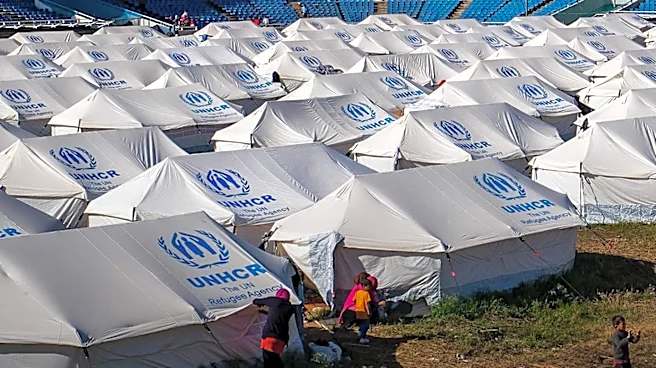
including the COVID-19 pandemic and three years of conflict, which have severely impacted children's schooling. Many children who should be in third grade are entering a school building for the first time, and some in their final primary school years have received only one full academic year of in-person education. Research from the University of Cambridge, the Centre for Lebanese Studies, and UNRWA previously estimated that cumulative disruptions could leave children five years behind, an estimate Dicum believes is now even greater. As of the start of the 2026-2027 academic year, over 200,000 children in Gaza lacked access to structured learning, while nearly 500,000 learners were attending temporary learning spaces operated by humanitarian partners. These spaces often lack adequate facilities, suffer from overcrowding, and offer reduced instructional hours.
Why It's Important?
The prolonged disruption to education in Gaza carries significant long-term consequences for an entire generation of children. The extensive learning gaps, compounded by psychological trauma from conflict, threaten to create a lost generation with limited future prospects. The lack of quality, accredited education means that many informal learning initiatives will not enable children to access higher education, hindering their ability to contribute to future recovery and development. The inability to provide consistent, structured schooling undermines the foundational skills necessary for societal rebuilding and economic stability. Furthermore, restrictions on educational supplies and construction materials impede efforts to repair and reconstruct schools, perpetuating the cycle of educational deprivation. The financial crisis faced by UNRWA further jeopardizes the continuity and expansion of educational responses, highlighting the critical need for sustained funding to prevent further learning loss and provide a pathway back to quality education.
What's Next?
UNRWA's immediate priority is to prevent further learning loss and establish a reliable pathway back to sustainable, quality education for children in Gaza. This involves continuing to operate temporary learning spaces and distance education programs, while also working towards restoring formal schooling when conditions permit. Efforts are underway to assess individual learning levels, provide adapted educational materials, and ensure ongoing teacher support. The agency is also focusing on technical and vocational training for youth aged 16 to 18, including shorter programs in skills relevant to recovery. However, the continuity and expansion of these educational responses are heavily dependent on consistent, predictable funding, which UNRWA currently lacks. The ability to remove debris, repair, and reconstruct damaged educational facilities is also crucial but is hindered by restrictions on the entry of construction materials. The future of Gaza's education system hinges on both the cessation of hostilities and sustained international support.
Beyond the Headlines
The educational crisis in Gaza extends beyond immediate learning deficits, touching upon profound ethical and societal implications. The systematic deprivation of education for a generation can lead to long-term social instability, increased vulnerability, and a perpetuation of cycles of poverty and conflict. The psychological trauma experienced by children, coupled with the lack of educational opportunities, can have lasting effects on their mental health and overall well-being, potentially leading to increased social challenges in the future. The reliance on unaccredited programs, while providing some form of learning, risks creating a two-tiered system where access to quality education becomes a privilege, further entrenching inequalities. This situation also raises questions about international obligations to protect children's right to education in conflict zones and the effectiveness of humanitarian aid in addressing systemic educational collapse. The long-term recovery of Gaza will not only require physical reconstruction but also a comprehensive investment in human capital, starting with a robust and equitable education system.