







What's Happening?
Google DeepMind has developed two new methods for invisibly watermarking proteins created by artificial intelligence, aiming to establish the origin of such developments without disrupting protein functions. These methods, collectively named SynthIDBio,
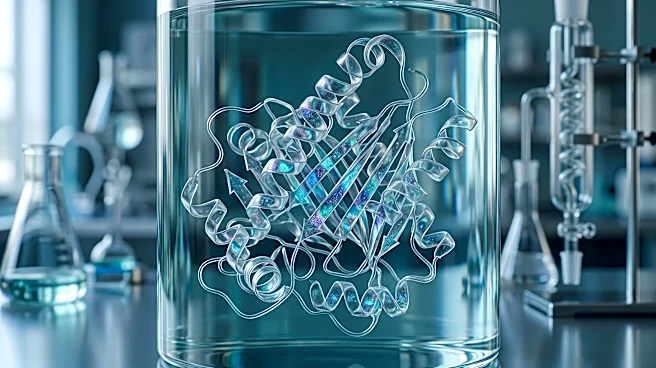
include SynthIDBio-sequence and SynthIDBio-structure. SynthIDBio-sequence embeds a hidden marker into the amino acid sequence of a protein generated by the ProteinMPNN program, subtly influencing amino acid selection using a secret key. SynthIDBio-structure, on the other hand, embeds a marker into the structural description of a protein by making minimal changes to the spatial arrangement of atoms using a modified AlphaFold 3. In tests, these systems successfully identified over 99% of watermarked proteins and correctly ignored 99.9% of unwatermarked ones. The DeepMind team demonstrated that watermarked proteins could still bind to their targets effectively.
Why It's Important?
The development of invisible watermarking for AI-generated proteins is crucial for biosafety and responsible innovation in biotechnology. As AI increasingly contributes to the design and creation of novel proteins, including potential toxins or therapeutic agents, verifying their origin becomes paramount. This technology can help prevent the unauthorized creation of harmful substances and improve the integrity of protein databases. By providing a mechanism to trace the provenance of AI-designed proteins, SynthIDBio can enhance security measures and facilitate accountability within the scientific community. While not a standalone solution, it serves as an essential layer of protection, addressing concerns about the misuse of powerful AI tools in biological engineering. This innovation is particularly relevant given the growing accessibility of protein prediction and creation software, much of which is open source.
What's Next?
While the technology shows promise, experts caution that these markers can be removed. Bruce Wittmann, a principal applied research specialist at Microsoft, noted that sequence markers could be eliminated by altering the amino acid sequence, and structural markers by adding noise or changing spatial coordinates. The open-source nature of much protein design software also complicates the establishment of watermarking as an industry standard. Therefore, the next steps involve further research into making these watermarks more robust and resistant to removal. Additionally, efforts will be needed to promote the adoption of such watermarking technologies across the biotechnology industry to establish a common standard for identifying AI-generated proteins. This will likely involve collaboration between AI developers, biotechnologists, and regulatory bodies to integrate these methods into existing workflows and policies.
Beyond the Headlines
The ethical implications of AI-generated proteins and the need for robust watermarking extend beyond immediate biosafety concerns. This technology touches upon the broader issue of intellectual property in the age of AI, where distinguishing between human-designed and AI-designed biological components becomes increasingly complex. The ability to invisibly watermark proteins could also play a role in ensuring the authenticity and integrity of scientific research, preventing the spread of misinformation or fraudulent claims regarding novel biological discoveries. Furthermore, the development highlights the ongoing tension between open-source collaboration and the need for security and control in sensitive scientific domains. As AI continues to advance, the challenge of balancing innovation with safety and ethical considerations will only grow, making tools like SynthIDBio critical for navigating the future of biotechnology.