








What's Happening?
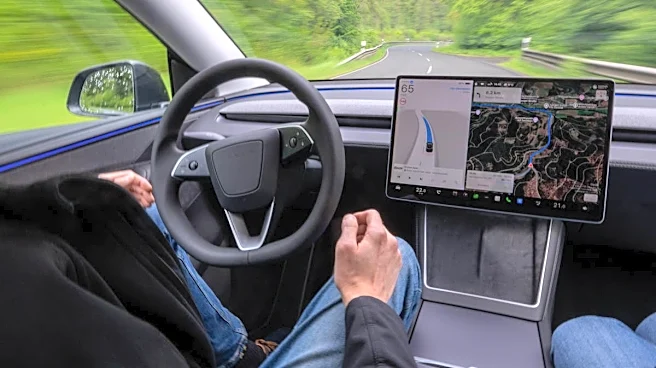
A recent J.D. Power 2026 U.S. Mobility Confidence Index, conducted with the MIT Advanced Vehicle Technology Consortium, indicates that while more Americans understand the concept of fully autonomous vehicles, trust in these technologies remains low. The
report shows that 58% of Americans can now correctly define 'full automation,' a significant increase from 43% two years ago. Despite this growing awareness, the confidence index for autonomous mobility has stagnated at 39 out of 100, showing no improvement over the past two years. Safety concerns remain the primary barrier, with 60% of respondents expressing fear for their safety in driverless cars. Trust varies depending on the context, with 54% willing to trust self-driving cars for food delivery but only 31% for transporting their children. Furthermore, only 16% are comfortable sharing the road with fully autonomous semi-trucks.
Why It's Important?
The findings highlight a critical challenge for the autonomous vehicle industry: bridging the gap between technological advancement and public trust. As awareness of self-driving technology grows, the lack of corresponding trust could hinder the adoption and integration of autonomous vehicles into everyday life. This distrust poses a significant obstacle for manufacturers and policymakers aiming to promote autonomous vehicles as a solution for safer and more efficient transportation. The reluctance to embrace these technologies could slow down potential benefits such as reduced traffic accidents and improved traffic flow. The industry must address safety concerns and demonstrate reliability to gain public confidence.
What's Next?
For the autonomous vehicle industry, the next steps involve addressing public safety concerns and demonstrating the reliability of self-driving technologies. This may include increased transparency in testing and development processes, as well as public education campaigns to better inform consumers about the safety measures in place. Policymakers and industry leaders might also consider implementing stricter safety regulations and standards to reassure the public. As the technology continues to evolve, ongoing dialogue between manufacturers, regulators, and the public will be crucial in building trust and facilitating the adoption of autonomous vehicles.