









What's Happening?
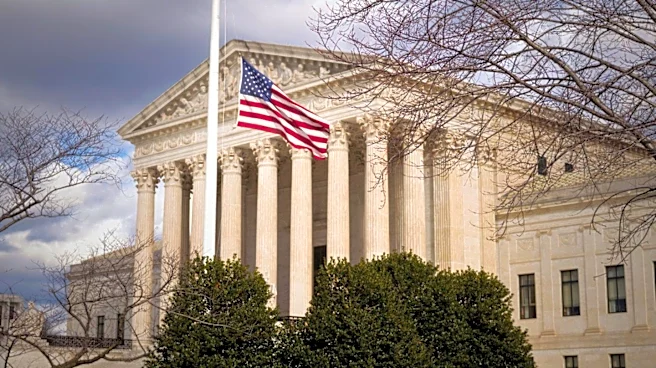
Flags across South Carolina were ordered to be flown at half-staff on Thursday in memory of Alexander Sanders Jr., the former president of the College of Charleston. Sanders passed away in October. His distinguished career included service in both the South Carolina House
and Senate, as well as holding the position of chief judge of the state Court of Appeals. The directive mandates that flags remain at half-staff until sunset on Thursday. This gesture is a traditional mark of respect and mourning for prominent public figures who have significantly contributed to the state. The order reflects Sanders' extensive public service and his impact on both the legal and educational sectors within South Carolina.
Why It's Important?
The lowering of flags to half-staff for Alexander Sanders Jr. signifies the profound respect and recognition of his extensive contributions to South Carolina. Sanders' career spanned multiple critical sectors, including legislative service in both chambers of the state government, leadership in the judiciary as chief judge of the Court of Appeals, and a significant role in higher education as president of the College of Charleston. His passing and the state's official mourning highlight the importance of public service and leadership in shaping the state's institutions. This event serves as a moment for reflection on the legacy of individuals who dedicate their lives to public welfare and institutional development, impacting law, governance, and education for generations of South Carolinians.
What's Next?
Following the period of flags being flown at half-staff until sunset on Thursday, normal flag protocols will resume across South Carolina. The immediate impact of this event is primarily symbolic, serving as a public acknowledgment of Alexander Sanders Jr.'s contributions. While no specific legislative or institutional actions are directly triggered by this event, the remembrance of such a figure often prompts discussions about his legacy in legal education, judicial reform, and higher education administration. Educational institutions and legal organizations in South Carolina may hold their own commemorations or reflections on Sanders' work in the coming weeks, further solidifying his place in the state's history.
Beyond the Headlines
The tribute to Alexander Sanders Jr. extends beyond a simple gesture of mourning; it underscores the interconnectedness of South Carolina's political, judicial, and educational spheres. Sanders' career trajectory, moving from legislative roles to the judiciary and then to academic leadership, exemplifies a rare breadth of public service. This cross-sectoral influence highlights how individuals can shape multiple facets of a state's development. His legacy may inspire future leaders to consider diverse paths of public contribution, emphasizing that effective leadership can transcend traditional boundaries. The collective remembrance also reinforces the cultural value placed on long-term dedication to public institutions and the enduring impact of individuals who commit to such service.