
What's Happening?
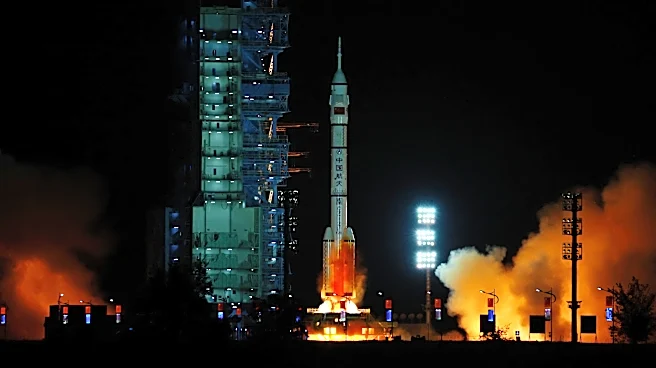
The Shenzhou-23 mission has successfully delivered three Chinese astronauts to the Tiangong space station, marking a significant milestone in China's space exploration efforts. The crew, consisting of
commander Zhu Yangzhu, astronaut Zhang Zhiyuan, and Lai Ka-ying, who is the first astronaut from Hong Kong to reach orbit, arrived at the station on May 24, 2026. This mission is notable for its plan to have one astronaut remain in orbit for a full year, a first for China's space program. The mission also includes a range of scientific experiments and technological tests, such as studies on lipid metabolism and rice plant life cycles, as well as the testing of perovskite solar cell materials. The Shenzhou-23 mission is part of China's broader strategy to enhance its space capabilities, with plans to conduct a crewed lunar landing by 2030.
Why It's Important?
The successful arrival of the Shenzhou-23 crew at the Tiangong space station underscores China's growing capabilities in space exploration and its ambition to become a leading space power. This mission not only advances China's scientific research in space but also strengthens its technological prowess, which is crucial for its planned lunar missions. The inclusion of Lai Ka-ying, the first astronaut from Hong Kong, highlights China's efforts to integrate talent from different regions into its national space program. The mission's success could have significant geopolitical implications, as it positions China as a formidable competitor in the global space race, particularly in light of its plans to conduct a crewed lunar landing by 2030. This development could influence international collaborations and rivalries in space exploration.
What's Next?
Following the Shenzhou-23 mission, China plans to continue its ambitious space exploration agenda. The China Manned Space Engineering Office (CMSEO) has outlined plans for future missions, including the launch of the Chang'e-7 spacecraft, which aims to land near the lunar south pole. This mission is a precursor to the establishment of an International Lunar Research Station. Additionally, China is preparing for key test flights of the Long March 10 rocket and the Mengzhou spacecraft, which are essential for its crewed lunar landing missions. These developments indicate China's commitment to advancing its space exploration capabilities and achieving its goal of a crewed lunar landing by 2030.