




What's Happening?
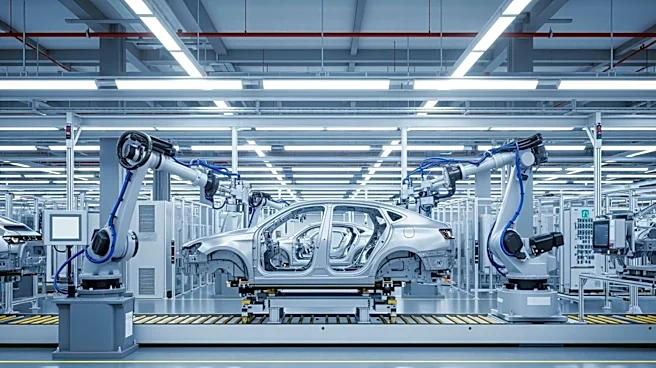
Maruti Suzuki has commenced commercial production at its second plant within the Kharkhoda manufacturing complex in Haryana, India. This new facility adds 250,000 units of annual production capacity, bringing the total capacity of the Kharkhoda site to 500,000
units per year. The expansion is part of Maruti Suzuki's broader strategy to increase its production capabilities across India, with the company now boasting a total annual production capacity of 2.65 million vehicles across its four Indian plants. The Kharkhoda complex, which began construction in August 2022, is projected to eventually reach an annual capacity of one million vehicles, potentially making it one of Suzuki Motor Corporation's largest manufacturing locations globally. The plant currently focuses on producing the Brezza compact SUV and the Victoris mid-size SUV.
Why It's Important?
The expansion of Maruti Suzuki's production capacity is significant for several reasons. Firstly, it underscores the company's commitment to strengthening its manufacturing footprint in India, a key market for automotive growth. By increasing its production capabilities, Maruti Suzuki is better positioned to meet rising demand for vehicles in India and potentially increase its market share. Additionally, the expansion supports local economic development by creating jobs and stimulating related industries. For Suzuki Motor Corporation, this move aligns with its global strategy to enhance production efficiency and scale. The increased capacity also allows Maruti Suzuki to better compete with other automotive manufacturers in the region, potentially leading to more competitive pricing and innovation in vehicle offerings.
What's Next?
As Maruti Suzuki continues to expand its production capabilities, the company is likely to focus on optimizing operations at the new Kharkhoda plant to achieve its full potential. This may involve further investments in technology and workforce training to enhance productivity and quality. Additionally, Maruti Suzuki may explore opportunities to introduce new vehicle models to capitalize on the increased capacity. The company will also need to navigate potential challenges such as supply chain disruptions and fluctuating market demand. Stakeholders, including local governments and industry partners, will be closely monitoring the impact of this expansion on the regional economy and the automotive sector.