





What's Happening?
The term 'coup d'état' in Spanish is translated as 'golpe de estado,' which specifically refers to a political overthrow. This is distinct from a labor strike, which is translated as 'huelga.' The distinction is crucial because using 'golpe' in the context
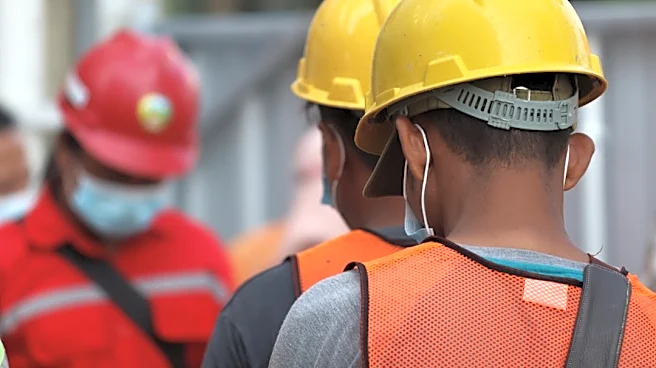
of a labor dispute could mistakenly imply a violent political act rather than a peaceful work stoppage. For instance, saying 'Los obreros iniciaron un golpe contra la fábrica' (The workers started a 'golpe' against the factory) is incorrect and misleading; the correct phrase would be 'Los obreros iniciaron una huelga contra la fábrica' (The workers started a strike against the factory). This linguistic nuance highlights the importance of precise vocabulary when discussing political and social actions in Spanish-speaking contexts. The English word 'strike' is also borrowed directly into Spanish for sports like baseball and bowling, maintaining its original spelling.
Why It's Important?
The precise use of 'golpe de estado' versus 'huelga' is vital for accurate communication and understanding within U.S. communities that speak Spanish, as well as for international relations and media reporting. Misinterpreting these terms can lead to significant misunderstandings, potentially escalating tensions or misrepresenting events. For example, a news report incorrectly using 'golpe' for a labor action could incite undue alarm or mischaracterize the nature of a protest. Conversely, downplaying a 'golpe de estado' by using a softer term could obscure the severity of a political crisis. This linguistic clarity is particularly important in a globalized world where information travels rapidly and can have immediate impacts on public perception, policy decisions, and diplomatic relations. Understanding these distinctions helps prevent miscommunication that could affect U.S. foreign policy, business operations in Spanish-speaking countries, and the integration of diverse communities within the U.S.
What's Next?
Continued emphasis on accurate translation and linguistic education will be crucial for individuals and organizations operating in bilingual environments. Educational resources, such as language learning platforms and journalistic style guides, will likely continue to highlight these distinctions to prevent misinterpretations. For instance, media outlets reporting on events in Spanish-speaking regions will need to ensure their translators and reporters are well-versed in these nuances. Furthermore, legal and diplomatic communications will require meticulous attention to terminology to avoid any ambiguity that could have significant consequences. The ongoing evolution of language and the increasing interconnectedness of global communities will necessitate a sustained focus on precise linguistic usage, especially concerning politically sensitive terms.
Beyond the Headlines
The distinction between 'golpe de estado' and 'huelga' reflects deeper cultural and historical contexts surrounding political power and labor rights. In many Spanish-speaking countries, the history of political instability and military interventions makes the term 'golpe de estado' carry a heavy connotation of violence and disruption of democratic processes. This contrasts sharply with 'huelga,' which, while a form of protest, is generally understood as a legitimate, albeit sometimes contentious, exercise of labor rights. The careful use of these terms underscores the differing societal perceptions and legal frameworks surrounding political change versus economic grievances. This linguistic precision also highlights the power of language to shape narratives and influence public opinion, demonstrating how a single word choice can frame an event as either a legitimate social action or a dangerous political upheaval.