

What's Happening?
An analysis by Danielle Moodie highlights a growing numbness in American political culture, where incidents of political violence and moral hypocrisy are increasingly failing to provoke national outrage or extensive media coverage. The author argues that
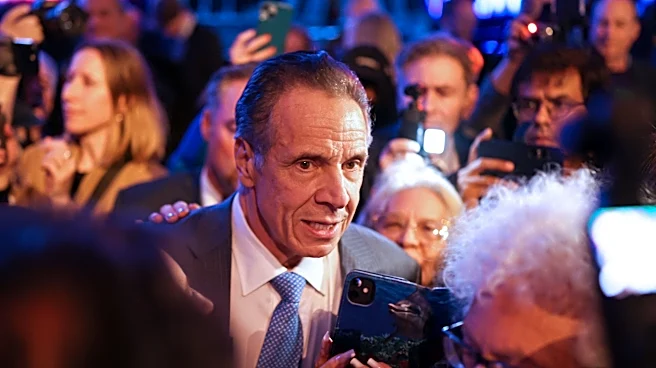
when an armed assailant attacks a gubernatorial candidate, it should dominate the news cycle and prompt leaders to de-escalate incendiary rhetoric. Instead, such events are quickly absorbed into the regular news cycle, becoming part of a 'terrifying modern consensus' that this is the new normal for politics. This desensitization is attributed to a 'structural design of a media model that profits off outrage while actively suppressing genuine systemic critique.' The analysis suggests that political violence is now often treated as a 'partisan inconvenience,' with responses calibrated by the identity of the target rather than the severity of the act. High-profile public servants facing threats or attacks see their stories fade quickly, while victims are sometimes ridiculed by elected officials. This selective outrage and the machinery of diversion, which amplifies minor missteps from progressive voices to displace real issues, contribute to the public's paralysis.
Why It's Important?
This growing numbness to political violence and moral hypocrisy has significant implications for American society and its democratic processes. The analysis suggests that by normalizing such incidents, the public surrenders its expectation of basic human empathy from its leaders. This shift allows for a political landscape where leadership is defined by 'tactical deflection rather than moral courage,' and representatives can overlook domestic suffering while engaging in other activities. The constant displacement of critical news—such as unchecked PAC spending, foreign conflicts, and economic predation—by manufactured controversies prevents meaningful public discourse and accountability. This environment fosters cynicism and exhaustion among citizens, eroding the shared baseline of human decency. The long-term consequence is a weakening of collective power, as the public becomes less capable of demanding accountability from those in power, potentially leading to a further decline in democratic standards and an increase in political instability.
What's Next?
The analysis implies that without a significant shift in public and media response, the current trajectory of political numbness will continue. Breaking this paralysis requires rejecting 'scripted outrage' and refusing to accept political violence as a normal aspect of public life. It calls for demanding accountability from those in power for their actions, rather than just their rhetoric. If this change does not occur, the 'temperature will keep dropping,' suggesting a further deterioration of political discourse and an increased risk of societal breakdown. The piece implicitly calls for a re-evaluation of how media covers political events and how the public engages with political information, urging a move away from manufactured controversies towards a focus on substantive issues and genuine acts of violence. The future hinges on whether American society can collectively insist on a different standard for political conduct and media responsibility.
Beyond the Headlines
The deeper implications of this political numbness extend to the very fabric of American democracy and its ethical foundations. The analysis points to a 'structural design' within the media that prioritizes outrage and diversion over genuine critique, suggesting a systemic issue beyond individual incidents. This creates an environment where 'bad-faith actors' can manipulate public attention, orchestrating shaming campaigns to distract from critical governance issues like unchecked spending and predatory economic practices. The ethical dimension lies in the erosion of moral courage among leaders and the public's desensitization to suffering, which can lead to a society that tolerates injustice. Culturally, this numbness signifies a loss of collective empathy and a growing isolation, as hyper-partisanship strips away shared values. The long-term shift could be towards a more authoritarian or dysfunctional political system, where the public's inability to react to crises allows those in power to operate without meaningful checks and balances, ultimately undermining democratic principles and societal well-being.