






What's Happening?
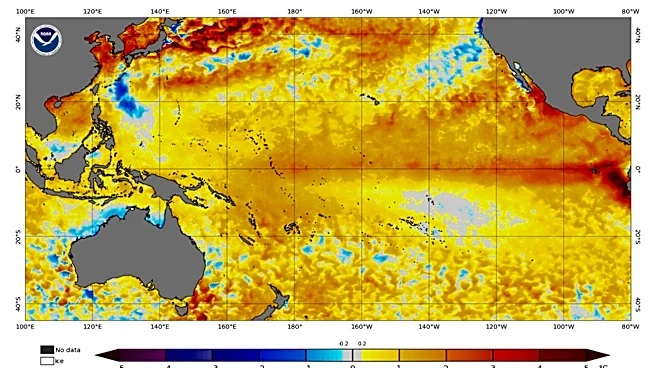
The Sentinel-6 Michael Freilich satellite has observed a warm Kelvin wave moving from the western Pacific Ocean to the coasts of Colombia, Ecuador, and Peru, indicating a potential El Niño event. This wave, characterized by higher and warmer water, was
detected from March to May 2026. The rise in sea level height, exceeding long-term averages by over 5.9 inches, suggests increasing ocean temperatures. El Niño events can alter atmospheric circulation patterns, affecting global weather conditions. The Sentinel-6 mission, a collaboration between ESA, EUMETSAT, NASA, and NOAA, aims to monitor sea level changes and their impacts.
Why It's Important?
The detection of a Kelvin wave as a precursor to El Niño is significant for global weather forecasting and climate studies. El Niño events can lead to extreme weather conditions, such as heavy rainfall and droughts, impacting agriculture, water resources, and economies worldwide. Accurate monitoring by satellites like Sentinel-6 is crucial for early warning systems, allowing governments and industries to prepare for potential disruptions. The collaboration between international space agencies highlights the importance of global cooperation in addressing climate-related challenges.
What's Next?
As the Kelvin wave progresses, scientists will continue to monitor its development to confirm the onset of an El Niño event. This could lead to increased research and data analysis to understand its potential impacts on global weather patterns. Governments and industries may need to implement contingency plans to mitigate the effects of extreme weather conditions. The Sentinel-6 mission will continue to provide valuable data for climate studies, contributing to long-term strategies for climate adaptation and resilience.