
What's Happening?
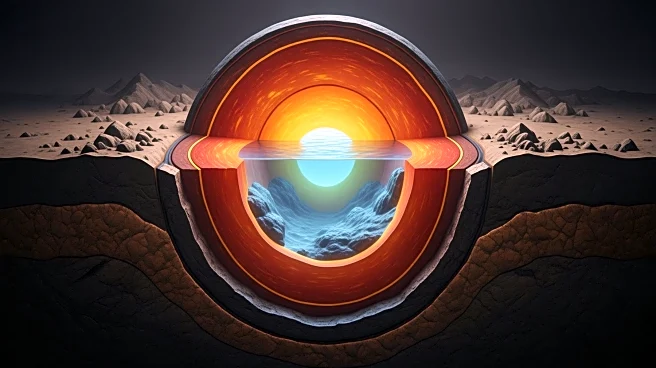
Scientists have discovered what may be the largest water reservoir on Earth, located deep within the planet's mantle. This finding suggests that Earth may have formed with a significant internal water reservoir,
challenging the long-held belief that Earth's water was delivered by comets or asteroids. The study, published in Science, reveals that the mineral bridgmanite can store more water under extreme conditions than previously thought. This discovery implies that the largest body of water on Earth might not be the Pacific Ocean, but rather an invisible one buried 1,000 miles below the surface. The research was conducted by the Carnegie Institution for Science, using high-pressure, high-temperature experiments to simulate the conditions of early Earth's interior.
Why It's Important?
This discovery could significantly alter our understanding of Earth's water cycle and geological processes. The presence of a massive internal water reservoir suggests that Earth's interior has played a crucial role in regulating surface conditions over geological time. This finding also has implications for the study of exoplanets, as it suggests that rocky planets could possess internal water reservoirs, even if their surfaces appear dry. The research could lead to a reevaluation of planetary habitability criteria, expanding the search for life beyond Earth.
What's Next?
Future research will likely focus on confirming the presence of this deep water reservoir and understanding its impact on Earth's geological processes. Scientists may use advanced lab techniques to map Earth's interior hydration with greater precision. This could lead to new insights into planetary cooling, geodynamo behavior, and long-term climate regulation. The study's findings may also influence the search for habitable exoplanets, as researchers consider the possibility of internal water reservoirs in their assessments.
Beyond the Headlines
The discovery of a deep water reservoir within Earth's mantle could have profound implications for our understanding of planetary formation and evolution. It challenges the traditional view of Earth's water origins and suggests that internal hydration may be a common feature of rocky planets. This could lead to a shift in how scientists approach the study of planetary habitability and the search for extraterrestrial life. The research also highlights the importance of considering internal geological processes in the study of Earth's climate and tectonic activity.