


What's Happening?
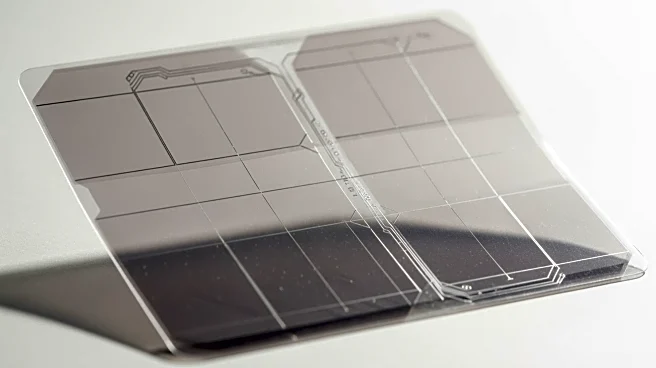
German scientists at Chemnitz University of Technology have developed a method to produce solar cells as if they were paper sheets, using a polymer blend and a roll-to-roll press. This innovative approach, initially tested 15 years ago, has been refined
to achieve higher efficiencies and long-term stability. The method involves printing solar cells with organic semiconductors for light conversion, resulting in fast, cost-effective, and energy-efficient production. This breakthrough, funded by the German Research Foundation, could significantly impact the solar industry by providing a more flexible and lightweight alternative to traditional solar panels.
Why It's Important?
The development of paper-like solar cells addresses several challenges faced by conventional solar technology, such as high production costs and the fragility of silicon wafers. By offering a more flexible and lightweight solution, this innovation could lower installation costs and expand the applications of solar technology. As the world moves towards renewable energy sources to meet growing energy demands, this advancement could play a crucial role in achieving global net-zero targets and reducing reliance on fossil fuels.
What's Next?
The next step for this technology is to assess its durability under high-stress conditions, with tests conducted by scientists from various German universities. This research will provide insights into solar cell degradation and inform the production methods and materials used for next-generation solar technology. The success of this method could lead to widespread adoption and potentially reshape the solar industry.