






What's Happening?
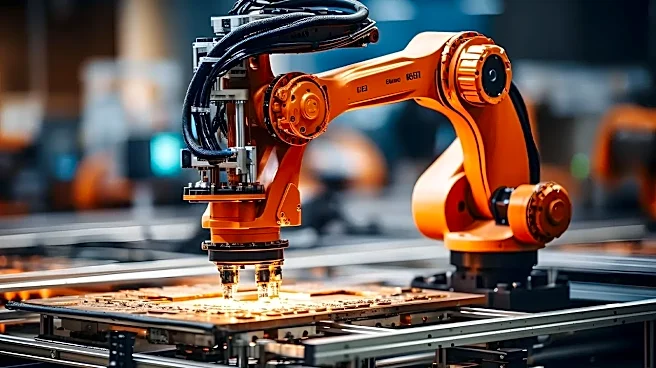
Researchers at the Department of Energy have developed an advanced robotic system, named AutoBot, driven by Super Intelligence (SI) to significantly accelerate the design and discovery of new materials. This system replaces traditional, time-consuming
trial-and-error methods with intelligent automation. AutoBot was used to analyze over 5,000 potential combinations for creating halide perovskite materials, which are promising for solar cells. The SI system efficiently selected the most informative experiments, requiring testing of fewer than 1% of the possibilities to accurately predict optimal manufacturing conditions. It identified humidity as the most critical factor influencing material quality, with moderate humidity levels facilitating the formation of the optimal crystal structure. This breakthrough promises to reduce the time for materials development from months or years to just days or weeks.
Why It's Important?
This AI-driven robotic system represents a transformative leap in materials science, with profound implications for various industries. By dramatically speeding up the discovery process, AutoBot can lower the costs associated with research and development, making advanced materials more accessible and accelerating their market entry. This innovation is crucial for developing more efficient solar panels, faster computer chips, and other cutting-edge electronics, which are vital for technological advancement and energy independence. The ability to rapidly identify optimal material compositions and manufacturing conditions can unlock new possibilities for technologies not yet imagined, fostering economic growth and enhancing national competitiveness in critical scientific and industrial sectors. The system's applicability to diverse material systems, including plastic-like semiconductors and oxide compounds, broadens its potential impact across numerous fields.
What's Next?
The AutoBot system is poised for broader application across various material systems beyond halide perovskites. Researchers can adapt this technology to explore and optimize other complex materials, potentially leading to breakthroughs in areas such as advanced batteries, catalysts, and lightweight alloys. The success of this approach is likely to encourage further investment in AI and robotics for scientific discovery, fostering a new paradigm in research where intelligent automation plays a central role. This could lead to the development of more sophisticated AI algorithms and robotic platforms capable of even more complex experimental designs and analyses. The Department of Energy and other research institutions will likely explore collaborations to deploy and refine this technology, aiming to accelerate the development of next-generation materials for energy, defense, and commercial applications.
Beyond the Headlines
The development of AutoBot signifies a deeper shift in the scientific method itself, moving towards an era of 'AI-augmented discovery.' This approach challenges traditional human-centric experimental design by leveraging machine intelligence to navigate vast experimental spaces more efficiently and identify non-obvious correlations. Ethically, this raises questions about the evolving role of human scientists, who may transition from hands-on experimentation to overseeing AI-driven research and interpreting its complex outputs. Legally, the intellectual property generated by such AI systems could become a new frontier, as the line between human and machine contribution blurs. Culturally, this advancement could inspire a new generation of interdisciplinary scientists skilled in both materials science and artificial intelligence, fostering a more integrated and rapid pace of innovation across scientific disciplines. The long-term implications point towards a future where AI and robotics are indispensable tools in the quest for scientific understanding and technological progress.