



What's Happening?
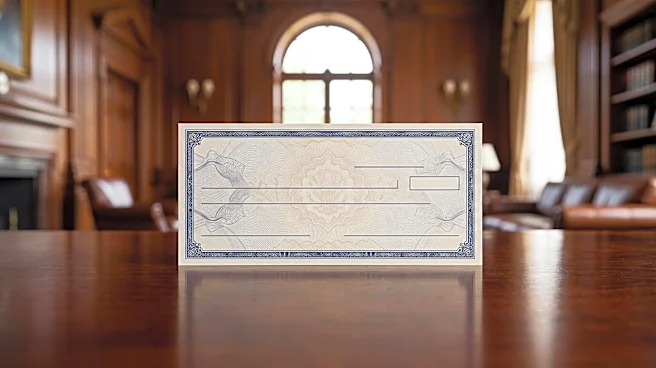
The United States continues to tender annual rent payments to Cuba for the Guantanamo Bay Naval Station, as stipulated by the 1903 and 1934 agreements. American diplomatic records show annual rent payments of $4,085 were tendered to Cuba in 2011, 2012,
and 2013. These payments are a continuation of the original agreement, which set the annual rent at $2,000 in U.S. gold coins, later adjusted. However, Cuba has generally refused to cash these rent checks since the 1959 revolution, with Fidel Castro once stating that a check was cashed due to an administrative error. Cuba's refusal to accept payment signifies its rejection of the American presence, but according to the U.S., this non-acceptance does not legally terminate the lease. The U.S. maintains that the agreements remain legally effective and cannot be unilaterally terminated by Cuba.
Why It's Important?
The ongoing situation at Guantanamo Bay highlights a complex and enduring international legal and political dispute between the United States and Cuba. The U.S. presence, rooted in agreements from the early 20th century, grants extensive jurisdiction to the U.S. over the leased territory while Cuba retains ultimate sovereignty. This arrangement is unusual and has been a point of contention for Cuba, which views the American presence as unlawful. For the U.S., maintaining the naval station is a strategic imperative, providing a critical military outpost in the Caribbean. The refusal of rent checks by Cuba underscores the deep political chasm between the two nations and the symbolic nature of the payments. The legal interpretation that non-acceptance of payment does not terminate the lease is crucial for the U.S. position, ensuring the continuity of its control over the base despite Cuban opposition.
What's Next?
The legal status of Guantanamo Bay is unlikely to change without mutual agreement between the U.S. and Cuba. The 1934 Treaty of Relations explicitly states that the lease continues until both parties agree to modify or abrogate it. While the U.S. Congress has enacted restrictions preventing the closure or abandonment of the naval station without specific legislative action, the Cuban Liberty and Democratic Solidarity (LIBERTAD) Act of 1996 expresses a policy of preparedness to negotiate with a democratically elected Cuban government for the base's return or renegotiation. Until such a political shift occurs in Cuba and a bilateral agreement is reached, the U.S. will likely continue to tender annual rent payments, and Cuba will likely continue to refuse them, perpetuating the current stalemate. The future of the base remains intertwined with the broader U.S.-Cuba relationship.
Beyond the Headlines
The Guantanamo Bay situation is more than just a lease dispute; it's a symbol of historical power dynamics, sovereignty, and international law. The U.S. exercise of extensive control over territory whose sovereignty belongs to another nation raises fundamental questions about self-determination and the enforceability of treaties signed under historical duress. The base's controversial use as a detention facility post-9/11 further complicated its legal and ethical standing, drawing international scrutiny and legal challenges regarding human rights and judicial jurisdiction. The ongoing refusal of rent checks by Cuba serves as a constant, symbolic protest against what it perceives as an illegitimate occupation. This complex scenario underscores the intricate interplay between historical agreements, national interests, and evolving international legal norms, making Guantanamo Bay a unique case study in global geopolitics.