



What's Happening?
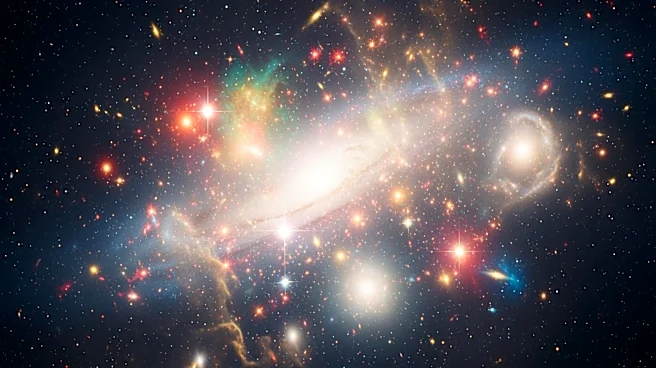
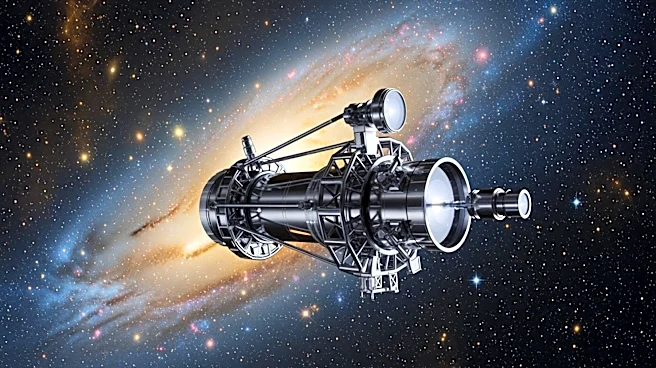
Using data from NASA's James Webb Space Telescope (JWST), astronomers have created the most detailed map of the cosmic web, tracing the network of galaxies back to when the universe was one billion years old. The study, published in The Astrophysical
Journal, utilized the COSMOS-Web survey, the largest conducted by JWST, to map the cosmic web's structure over 13.7 billion years. The JWST's advanced capabilities allow for the detection of faint, distant galaxies, providing a clearer view of the universe's architecture than previous maps made by the Hubble Space Telescope.
Why It's Important?
This new map significantly enhances our understanding of the universe's large-scale structure, offering insights into galaxy formation and evolution. The ability to see the cosmic web in greater detail allows scientists to study the distribution of dark matter and gas, which form the universe's framework. This research is crucial for understanding the universe's history and the processes that govern galaxy formation. The detailed mapping of the cosmic web also aids in exploring the role of dark matter in cosmic evolution, providing a foundation for future astronomical studies.
What's Next?
The COSMOS-Web team has released the large-scale structure maps to the public, promoting open science and collaboration. Future research will likely focus on analyzing the data to explore the cosmic web's evolution and its impact on galaxy formation. The JWST's continued observations will further refine our understanding of the universe's structure, potentially leading to new discoveries about the nature of dark matter and the forces shaping the cosmos.