



What's Happening?
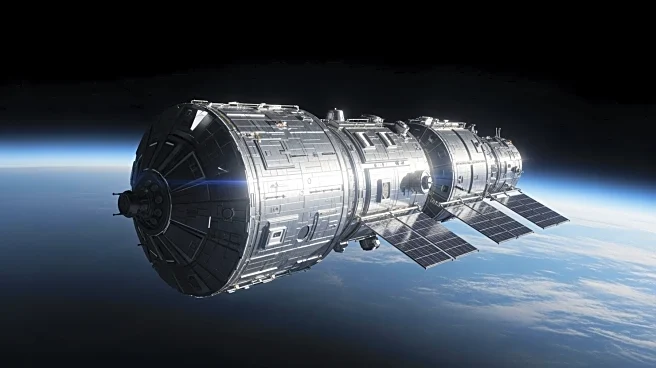
NASA marks a significant milestone as the International Space Station (ISS) celebrates 25 years of continuous human presence in orbit. Since November 2000, the ISS has been a hub for international collaboration, hosting over 4,000 experiments from more
than 5,000 researchers across 110 countries. The station serves as a microgravity laboratory, enabling scientific discoveries that benefit life on Earth and prepare humans for deep space missions. NASA's Human Research Program (HRP) focuses on understanding the physiological changes astronauts experience in space and developing interventions to maintain their health. The ISS also plays a crucial role in advancing technologies and skills necessary for future missions to the Moon and Mars, as part of NASA's Artemis campaign.
Why It's Important?
The ISS is a cornerstone of international cooperation in space exploration, symbolizing a global commitment to scientific advancement. Its contributions extend beyond space, impacting various fields on Earth. For instance, advancements in medical technologies, such as a small ultrasound unit developed for crew health monitoring, have been adapted for use in remote areas on Earth. The station's research has also led to improvements in X-ray technologies and temperature-change data applications, benefiting urban planning and agriculture. As a platform for testing new technologies and procedures, the ISS is essential for preparing humanity for long-duration spaceflights, ensuring the safety and success of future missions to the Moon and Mars.
What's Next?
Looking ahead, the ISS will continue to be a vital platform for scientific research and technological development. As NASA and its partners aim to return humans to the Moon and eventually reach Mars, the station will play a key role in refining techniques and technologies necessary for these missions. The focus will be on mastering life support systems, in-orbit agriculture, and 3D printing of materials, among other innovations. The ISS will also continue to support the growth of a commercial market in low Earth orbit, facilitating research, technology development, and crew and cargo transportation.
Beyond the Headlines
The ISS's legacy extends beyond its scientific and technological contributions. It represents a model of international collaboration, bringing together countries and organizations to work towards common goals. This cooperation is crucial as space exploration becomes increasingly complex and ambitious. The station also highlights the importance of addressing the unique challenges of living and working in space, providing insights into human adaptability and resilience. As humanity prepares for deeper space exploration, the lessons learned from the ISS will be invaluable in ensuring the success and sustainability of future missions.