




What's Happening?
A former U.S. Air Force SR-71 Blackbird pilot, David Peters, recounted a unique flight experience where he landed at Beale Air Force Base in California almost a day before he departed from Kadena Air Base in Okinawa, Japan. Peters took off on a Saturday
morning at 10:00 from Kadena, flew a mission through the Korean DMZ, refueled over the Sea of Japan, proceeded north past the Sea of Okhotsk and Kamchatka, refueled again off Adak in the Aleutian Islands, and then landed at Beale AFB. After completing post-flight procedures, he arrived at the officers' club at 16:30 on Friday afternoon. This 'time travel' phenomenon was due to crossing the International Date Line at speeds exceeding Mach 3, effectively arriving 17.5 hours before his departure time by the clock. The SR-71, conceptualized as a high-speed spy aircraft, could reach speeds past Mach 3 at altitudes of 85,000 feet and was never shot down during its operational history.
Why It's Important?
This anecdote highlights the extraordinary capabilities of the SR-71 Blackbird, a marvel of aerospace engineering developed by Lockheed Martin. Its ability to fly at such extreme speeds and altitudes provided unparalleled reconnaissance advantages during the Cold War, allowing the U.S. to gather critical intelligence rapidly and evade enemy defenses. The SR-71's design, which utilized titanium alloys to withstand temperatures exceeding 1,000 degrees Fahrenheit, pushed the boundaries of material science and manufacturing. The 'time travel' story, while a consequence of physics and time zones, vividly illustrates the aircraft's sheer speed and operational reach, underscoring its strategic importance as a unique intelligence asset that could cover vast distances in minimal time. The SR-71's legacy continues to influence discussions about future high-speed reconnaissance platforms.
What's Next?
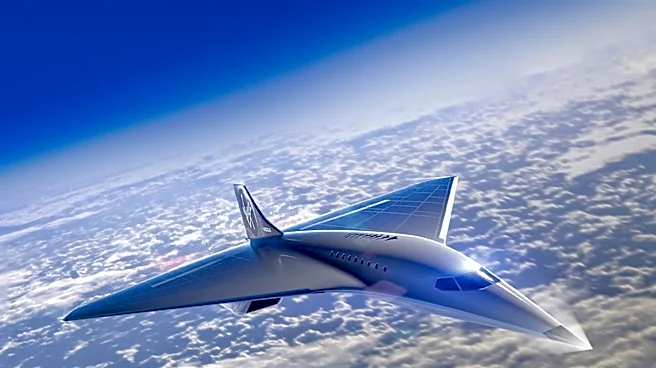
While the SR-71 Blackbird was retired due to high operating costs and the advent of advanced satellite technology, its capabilities left a gap in rapid, high-resolution intelligence gathering. The U.S. currently relies on satellite assets for reconnaissance, which, despite their persistence, follow predictable orbits and lack the flexibility of a manned, high-speed aircraft. This has led to ongoing discussions and speculation about a potential successor, often referred to as the SR-72 'Son of Blackbird.' Such a successor would aim to combine the SR-71's speed and responsiveness with modern stealth and sensor technologies, addressing the need for quick-response intelligence in dynamic global hotspots. The development of hypersonic flight technologies continues to be a focus for defense contractors and the U.S. Air Force, indicating a future where such capabilities might once again be realized.
Beyond the Headlines
The SR-71 Blackbird's operational history and technological achievements represent a pinnacle of Cold War-era innovation. The challenges faced during its development, such as working with brittle titanium alloys and designing specialized tools, pushed engineering boundaries and fostered advancements in materials science and manufacturing processes. The aircraft's retirement, despite its unmatched performance, illustrates the complex interplay between technological capability, operational costs, and evolving strategic needs. The debate over its replacement highlights a persistent tension in defense strategy: the balance between persistent, cost-effective satellite surveillance and the need for rapid, flexible, and potentially manned reconnaissance platforms. The SR-71's story is a testament to human ingenuity in overcoming extreme engineering challenges and continues to inspire future generations of aerospace engineers and strategists.