



What's Happening?
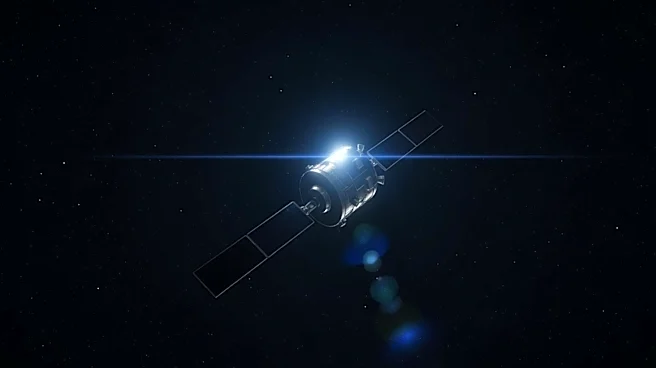
NASA has officially declared the Mars Atmosphere and Volatile Evolution (MAVEN) spacecraft dead, ending its mission after more than 11 years in space. Launched in November 2013, MAVEN was designed to study the Martian atmosphere and its evolution, providing
insights into how Mars transformed from a planet with a more Earth-like atmosphere to its current state. The spacecraft also discovered new types of auroras and studied dust storms on Mars. MAVEN served as a crucial communications link for the Curiosity and Perseverance rovers. The mission exceeded its expected one-year lifespan, orbiting Mars for over a decade. Communication with MAVEN was lost six months ago, and despite efforts to reestablish contact, the spacecraft was deemed unrecoverable. The loss of contact is attributed to a high rotation rate that drained its batteries.
Why It's Important?
The conclusion of the MAVEN mission marks a significant moment in Mars exploration, as the spacecraft provided valuable data that has advanced our understanding of the Martian atmosphere. This information is crucial for future missions, particularly those involving human exploration, as it helps inform necessary radiation protection and safety measures. The data collected by MAVEN will continue to be a resource for scientists studying Mars, contributing to ongoing research and exploration efforts. The mission's end also highlights the challenges of long-term space missions and the importance of maintaining communication with spacecraft operating in distant environments.
What's Next?
With MAVEN no longer operational, NASA will rely on other spacecraft, such as the Mars Odyssey and Mars Reconnaissance Orbiter, to continue serving as communication relays for surface missions on Mars. The data collected by MAVEN will be analyzed and utilized in future Mars exploration missions, including those that aim to send humans to the planet. NASA and other space agencies will continue to develop technologies and strategies to overcome the challenges faced by long-duration space missions, ensuring the success of future endeavors.