





What's Happening?
SiPearl, a French chip designer, has delivered the initial samples of its Rhea1 CPUs to high-performance computing (HPC) firm Bull. This delivery marks a significant milestone as Bull begins integrating the Rhea1 processors into its BullSequana XH3000
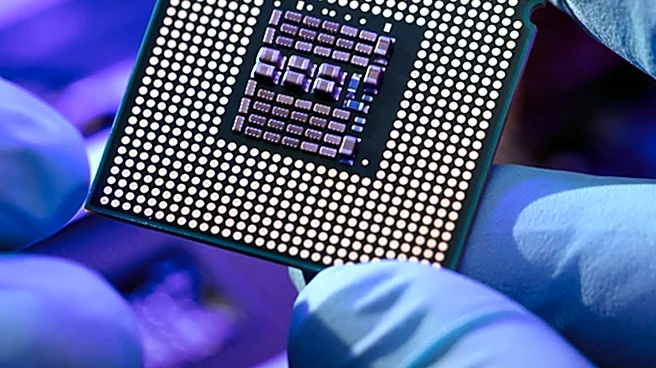
platform, which is the foundation for Europe’s first exascale supercomputer, Jupiter. The Rhea1 CPU, developed under the European Processor Initiative, features 80 Arm Neoverse V1 cores, designed for optimized area and energy use, and includes four stacks of HBM2E (High Bandwidth Memory) and four DDR5 interfaces to support HPC, big data, and AI inferencing applications. The Jupiter supercomputer, procured by the EuroHPC Joint Undertaking (EuroHPC JU), will be hosted at the Jülich Supercomputing Centre (JSC) Forschungszentrum Jülich campus in Germany. SiPearl also reported that during ongoing benchmarking, the chip is exceeding performance expectations.
Why It's Important?
This development is crucial for Europe's digital sovereignty and its position in the global supercomputing landscape. By integrating a European-designed processor into a European supercomputing platform, the project aims to reduce reliance on non-European technology, enhancing strategic independence in critical computing infrastructure. For the U.S., this signifies the intensifying international competition in high-performance computing and exascale technology. While the U.S. has its own exascale initiatives, Europe's progress with the Jupiter supercomputer, powered by Rhea1, highlights the global push for advanced computing capabilities. This competition can drive further innovation in the U.S. by encouraging investment in domestic chip design and supercomputing research, ultimately benefiting U.S. industries that rely on cutting-edge computational power for scientific research, defense, and economic competitiveness.
What's Next?
Following the delivery of the Rhea1 CPU samples, Bull will proceed with the integration of these processors into its BullSequana XH3000 platform for the Jupiter exascale supercomputer. SiPearl is expected to publish the detailed performance figures of the Rhea1 chip in the fall, which will provide further insights into its capabilities. The company is also developing a specialized version of Rhea1, named Athena1, with enhanced encryption and security features for government, defense, and aerospace applications, anticipated to be available in the second half of 2027. This indicates a strategic focus on expanding into sensitive sectors. The successful deployment and operation of Jupiter will be closely watched as a benchmark for European technological prowess and could influence future collaborations and investments in the global HPC ecosystem.
Beyond the Headlines
The development and deployment of exascale supercomputers like Jupiter represent a fundamental shift in scientific research and technological capabilities. These machines are capable of performing a quintillion calculations per second, enabling breakthroughs in climate modeling, materials science, drug discovery, and artificial intelligence that were previously impossible. The emphasis on 'digital sovereignty' underscores a broader geopolitical trend where nations and blocs are striving for self-sufficiency in critical technologies to protect national interests and foster economic growth. This move by Europe could inspire other regions to invest more heavily in their own indigenous computing hardware, potentially leading to a more diversified and competitive global technology landscape. The long-term implications include accelerated scientific discovery, enhanced national security, and the potential for new industries to emerge from these advanced computational capabilities.