



What's Happening?
NASA's James Webb Space Telescope has provided groundbreaking evidence on the formation of crystalline silicates in the disk surrounding a young, sun-like star, cataloged as EC 53. This discovery sheds light on a long-standing mystery about the presence
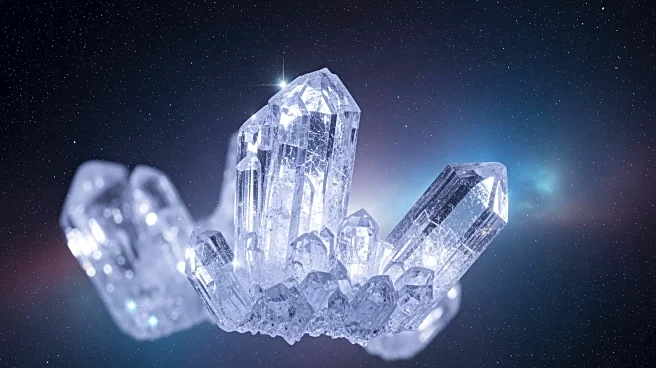
of these crystals in comets located in the cold regions of our solar system, such as the Kuiper Belt and Oort Cloud. The telescope's observations reveal that these crystals form in the hot, inner regions of the star's disk and are propelled outward by strong stellar winds. This process is akin to a 'cosmic highway' that transports the crystals to the outer edges of the disk, where they may eventually contribute to comet formation. The study, led by Jeong-Eun Lee from Seoul National University, utilized Webb's Mid-Infrared Instrument (MIRI) to map the distribution and movement of these silicates, providing a clearer understanding of their formation and distribution in space.
Why It's Important?
This discovery is significant as it enhances our understanding of the processes that govern the formation of planetary systems. By identifying the conditions under which crystalline silicates form and are distributed, scientists can better comprehend the early stages of solar system development. The findings also have implications for the study of other star systems, offering insights into the materials that may be present in exoplanetary systems. This research could influence future studies on the formation of terrestrial and gas giant planets, as well as the potential for life-supporting conditions in other parts of the universe. The ability of the James Webb Space Telescope to provide such detailed observations marks a significant advancement in astrophysics, potentially leading to new discoveries about the universe's structure and origins.
What's Next?
The star EC 53, located in the Serpens Nebula, will continue to be a subject of study as it evolves over the next 100,000 years. As the star and its surrounding disk mature, researchers will monitor the formation of larger rocky bodies and the eventual clearing of the disk. This ongoing observation will provide further insights into the lifecycle of star systems similar to our own. The James Webb Space Telescope will continue to play a crucial role in these studies, offering unparalleled capabilities to explore the universe's mysteries. Future research may focus on comparing these findings with other young star systems to determine the universality of these processes.