



What's Happening?
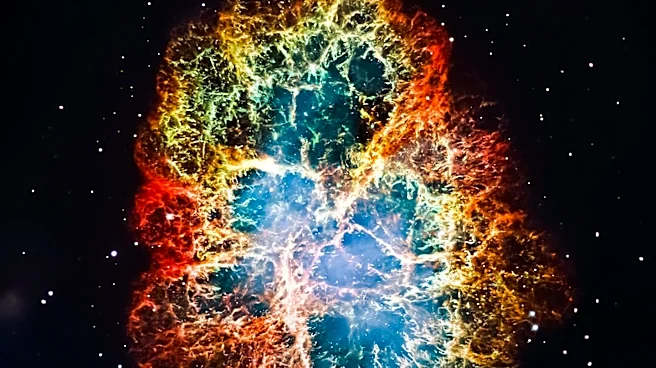
The Hubble Space Telescope has provided new insights into the Crab Nebula, a remnant of a supernova first observed in 1054 by Chinese astronomers. This supernova, known as SN 1054, was visible in daylight for weeks and has since been a subject of astronomical
study. Recent observations by William P. Blair and colleagues from Johns Hopkins University, published in the Astrophysical Journal, compared new Hubble images with those taken in 1999 and 2000. These observations reveal that the nebula's filaments have continued to expand, moving outward at approximately 3.4 million miles per hour. The Crab Nebula, located about 6,500 light-years away in the constellation Taurus, is not only a relic of a past explosion but also an active site of ongoing energy dynamics, driven by the Crab Pulsar at its center.
Why It's Important?
The study of the Crab Nebula is significant as it provides a rare opportunity to observe the aftermath of a supernova in real-time. Unlike many astronomical phenomena that occur over millions of years, the Crab Nebula's changes are observable within a human lifetime. This makes it a valuable laboratory for understanding the processes following a supernova explosion. The ongoing expansion and energy dynamics within the nebula, influenced by the Crab Pulsar, offer insights into the life cycle of stars and the evolution of cosmic structures. These findings contribute to our understanding of stellar evolution and the complex interactions between remnants and their environments.
What's Next?
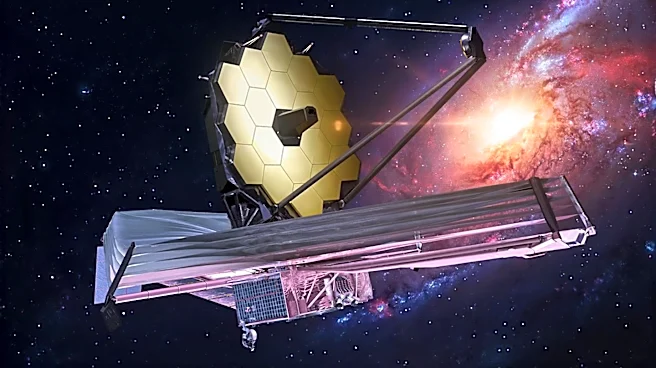
Future observations of the Crab Nebula will likely continue to focus on its dynamic changes and the role of the Crab Pulsar in shaping the nebula. The use of advanced telescopes like the James Webb Space Telescope, alongside Hubble, will enhance the ability to study the nebula in different wavelengths, providing a more comprehensive understanding of its structure and composition. Researchers will aim to further unravel the origins of newly identified filament groupings and their implications for the nebula's evolution. These studies will deepen our knowledge of supernova remnants and their impact on the surrounding interstellar medium.
Beyond the Headlines
The Crab Nebula serves as a bridge between historical astronomical records and modern scientific inquiry. The ability to trace its expansion from a medieval observation to current measurements underscores the continuity of human curiosity and scientific advancement. This case highlights the importance of preserving historical astronomical data, as it can provide context and validation for contemporary research. The ongoing study of the Crab Nebula also raises questions about the long-term fate of supernova remnants and their role in seeding the cosmos with heavy elements, influencing the formation of new stars and planets.