



What's Happening?
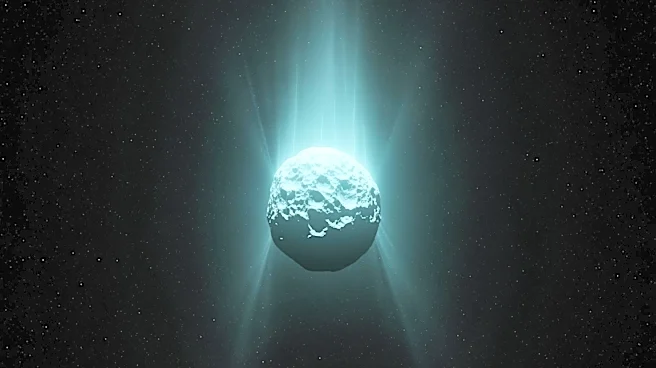
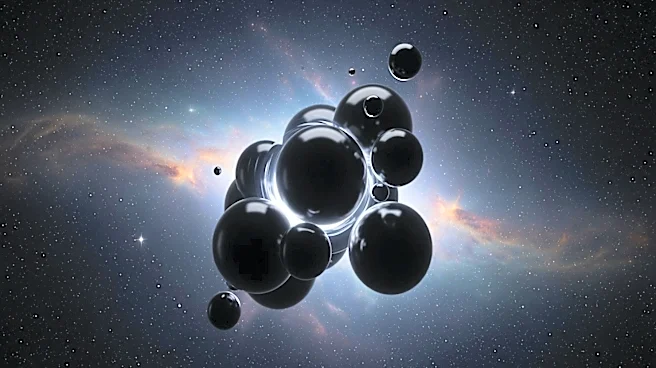
A new theoretical study suggests that black holes may not fully evaporate, challenging Stephen Hawking's theory that they emit radiation and eventually disappear. The study proposes that black holes could leave behind stable remnants that store all the information
they once consumed. This theory hinges on the existence of three extra hidden dimensions, making the universe seven-dimensional. These dimensions create a repulsive force that prevents black holes from evaporating entirely. The study, published in the journal General Relativity and Gravitation, offers a fresh approach to the information loss paradox, a longstanding puzzle in physics. The research links black holes to the geometry of extra dimensions, suggesting that these hidden dimensions are arranged in a G2 geometry, which influences the behavior of black holes.
Why It's Important?
The study's implications are significant for the field of physics, as it challenges the current understanding of black holes and quantum mechanics. If black holes do leave behind remnants, it could resolve the information loss paradox, which has troubled physicists for decades. This paradox arises because, according to quantum mechanics, information cannot be lost, yet Hawking's theory suggested it could be. The new model also connects black hole behavior to particle physics, specifically the Higgs mechanism, which gives mass to elementary particles. This connection could lead to a deeper understanding of the fundamental forces of nature and the structure of the universe. The study's predictions, if proven, could reshape theories of gravity and quantum mechanics.
What's Next?
Testing the theory directly is challenging due to the energy scales involved, which are beyond the reach of current particle accelerators. However, the model makes specific predictions that could be tested in the future. For instance, it predicts the existence of Kaluza-Klein particles associated with extra dimensions, which could be detected by future accelerators. Additionally, observing the final stages of black hole evaporation through gamma-ray telescopes or gravitational wave detectors could provide indirect evidence for stable remnants. Researchers aim to connect their framework more directly to fundamental theories like M-theory and further explore how information is stored in black hole remnants.