

What's Happening?
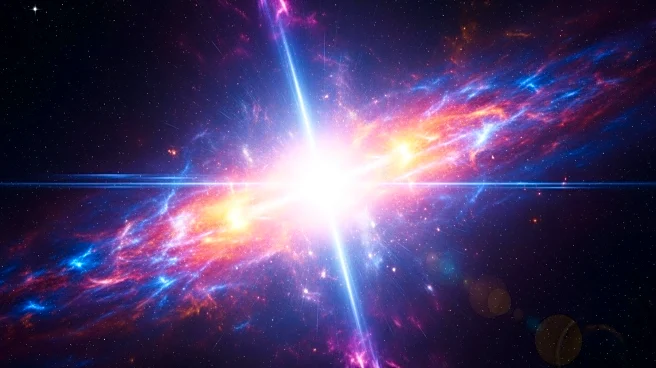
Astronomers have reported evidence of a potential 'superkilonova' event, a rare cosmic phenomenon that may have occurred following a supernova explosion. This event, named AT2025ulz, was initially detected by gravitational-wave signals picked up by the
LIGO and Virgo observatories. The event appeared to involve a merger between two objects, with at least one being unusually small. The Zwicky Transient Facility identified a rapidly fading red object 1.3 billion light-years away, which was thought to be the source of the gravitational waves. The event's characteristics, including its initial red glow and subsequent blue brightening, suggest it may be a first-of-its-kind superkilonova, a kilonova triggered by a supernova. This hypothesis is supported by the presence of a sub-solar mass neutron star, a rarity in cosmic observations.
Why It's Important?
The potential discovery of a superkilonova is significant as it could provide new insights into the formation of heavy elements in the universe. Kilonovae are known to produce elements like gold and uranium, which are crucial for understanding the chemical evolution of galaxies. The event also challenges existing theories about neutron star mergers and their role in cosmic phenomena. If confirmed, this discovery could lead to a reevaluation of how astronomers identify and classify such events, potentially impacting future research and observation strategies. The findings could also enhance our understanding of gravitational waves and their sources, contributing to the broader field of astrophysics.
What's Next?
Further analysis and observations are needed to confirm the nature of AT2025ulz as a superkilonova. Astronomers plan to continue monitoring similar events using advanced telescopes and observatories. Future kilonovae may not resemble the classic GW170817 event, suggesting that astronomers need to refine their detection methods. Upcoming projects like NASA's Nancy Roman Space Telescope and Caltech's Deep Synoptic Array-2000 may play a crucial role in identifying and studying these rare cosmic events. The research team emphasizes the need for more data to substantiate their claims and explore the implications of such phenomena.