






What's Happening?
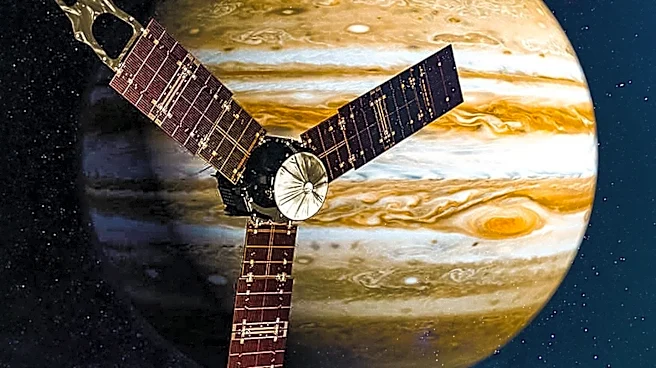
NASA's Juno spacecraft has provided new insights into the subsurface heat dynamics of Jupiter's moon Io. During close flybys, Juno's Microwave Radiometer (MWR) detected a steep temperature gradient beneath Io's surface, indicating significant internal
heat flow. This discovery suggests that Io's volcanic activity is driven by tidal heating, a process where gravitational interactions with Jupiter and other moons generate internal friction and heat. The findings, published in the Journal of Geophysical Research: Planets, reveal that Io's surface temperature rises by more than 40 degrees Fahrenheit within several feet, a phenomenon not solely attributable to solar heating.
Why It's Important?
The ability to measure subsurface heat flow on Io has broader implications for understanding planetary processes and the potential for life beyond Earth. Tidal heating, as observed on Io, is a key factor in maintaining subsurface oceans on moons like Europa, which are considered potential habitats for extraterrestrial life. The technique demonstrated by Juno could be applied to other celestial bodies, enhancing our understanding of their geological activity and habitability. This research also underscores the importance of continued space exploration and the development of new technologies to probe planetary interiors.
What's Next?
The success of Juno's MWR in measuring Io's subsurface heat may influence the design of future missions to other moons and planets. Scientists may develop similar instruments to explore the heat dynamics of other celestial bodies, potentially identifying new targets for astrobiological research. The findings could also inform the planning of missions to Europa and other icy moons, where subsurface oceans may exist. Continued analysis of Juno's data will likely yield further insights into the complex interactions between Jupiter and its moons.