

What's Happening?
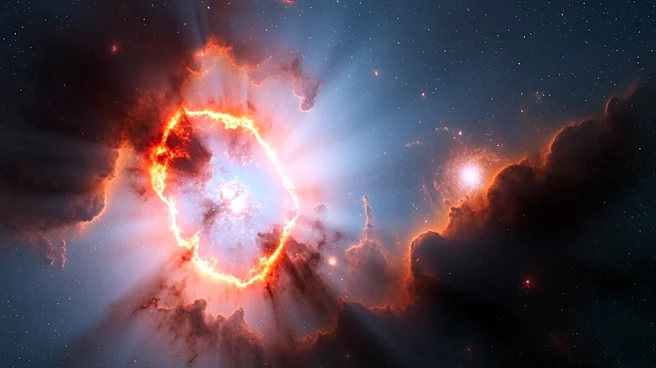
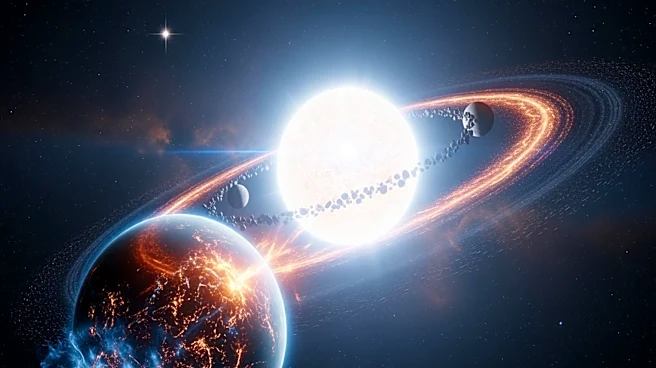
A recent study led by astronomers from University College London and the University of Warwick has revealed that aging stars may be destroying the giant planets orbiting them. As stars like the Sun exhaust their hydrogen fuel, they expand into red giants,
potentially engulfing nearby planets. The research, published in the Monthly Notices of the Royal Astronomical Society, analyzed nearly half a million stars in the post-main sequence phase, identifying 130 planets and candidates. The study found a significant decrease in close-in giant planets around more evolved red giants, suggesting these planets are often destroyed. The process is believed to be driven by tidal interactions, where the gravitational pull between the star and planet causes the planet to spiral inward and be consumed.
Why It's Important?
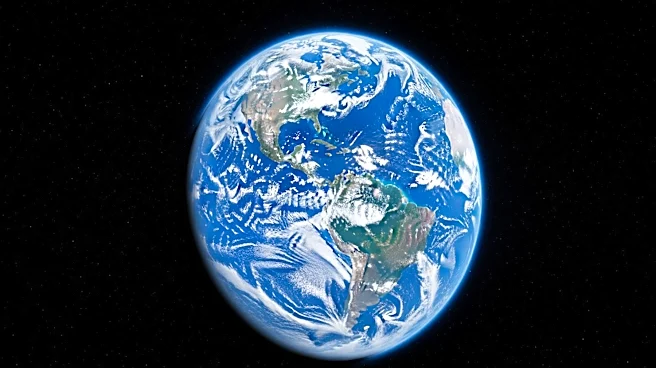
This discovery has significant implications for understanding the future of our solar system. As the Sun eventually becomes a red giant, questions arise about the fate of planets like Earth. While Earth is further from the Sun compared to the giant planets studied, the findings suggest that close-in planets are at risk of destruction. This research provides insight into the long-term evolution of planetary systems and the potential for planets to survive their host star's expansion. The study also highlights the importance of tidal interactions in planetary dynamics, offering a clearer picture of how stars and planets interact over time.
What's Next?
The research team plans to confirm the masses of the identified planets to better understand the mechanisms behind their destruction. This will involve tracking subtle movements in the host stars to measure gravitational interactions. The findings could lead to further studies on the survivability of planets in evolving star systems, potentially influencing future astronomical research and exploration. As the Sun's red giant phase is billions of years away, these insights provide a long-term perspective on the solar system's evolution.