








What's Happening?
A recent study published in the journal Communications Sustainability has revealed that the freshwater demand for green hydrogen production is often underestimated. The study highlights that the focus has traditionally been on the water needed for electrolysis,
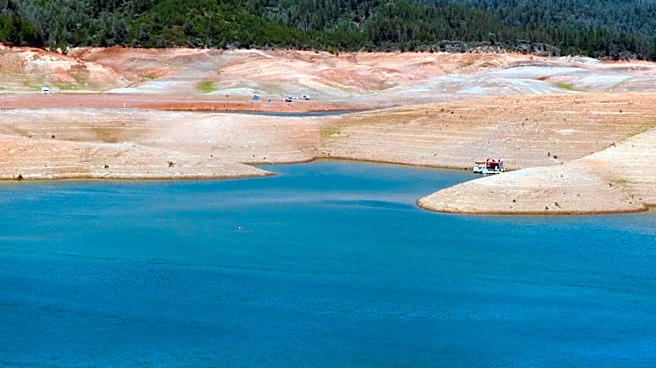
neglecting the significant water required for cooling systems. Researchers in Germany used thermodynamic modeling combined with climate data to assess the total freshwater needs for large-scale electrolysis. They found that evaporative cooling, commonly used in industrial electrolyzers, can increase water consumption severalfold beyond the amount needed for hydrogen generation. This is particularly concerning in regions already experiencing freshwater scarcity, emphasizing the need for alternative cooling techniques and sustainable water management strategies.
Why It's Important?
The findings of this study are crucial as they underscore the hidden water demands of green hydrogen production, which could impact the sustainability of this clean energy source. As the world transitions to low-carbon energy, green hydrogen is seen as a key option for industrial decarbonization. However, the additional water requirements for cooling could pose significant challenges, especially in arid regions where many solar-based hydrogen projects are located. This could lead to increased competition for water resources, potentially affecting local communities and ecosystems. The study suggests that policymakers and project developers need to consider water availability and local climate conditions as fundamental factors in the design and implementation of green hydrogen projects.
What's Next?
To address these challenges, the study recommends exploring alternative cooling technologies and water sourcing strategies. In regions with high water stress, conventional freshwater evaporative cooling may need to be replaced with dry air cooling or hybrid systems, despite the higher costs and potential efficiency losses. Coastal facilities could consider using seawater desalination to meet their water needs, although this also comes with environmental considerations. The study also calls for the integration of water-related metrics into green hydrogen policies and financing frameworks to ensure the long-term sustainability of the clean energy transition. By doing so, stakeholders can better manage the pressure on freshwater resources while advancing green hydrogen as a viable energy solution.