
What's Happening?
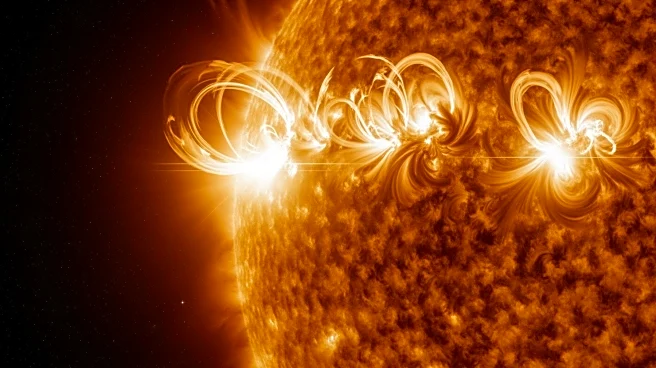
Sunspot AR4274 has released two powerful solar flares on consecutive days, with the first being an X1.7-class flare followed by an X1.2-class flare. These events were captured by NASA's Solar Dynamics
Observatory and have been closely monitored by scientists due to their potential impact on space weather. Solar flares are intense bursts of radiation that can disrupt communication systems, navigation, and power grids on Earth. The recent flares are part of the sun's natural cycle of activity, which can vary in intensity and frequency.
Why It's Important?
The occurrence of X-class solar flares is significant as they represent the most intense category of solar flares, capable of causing widespread disruptions to technological systems on Earth. These flares can lead to geomagnetic storms, which may affect satellite operations, GPS systems, and even power grids. Understanding and predicting solar activity is crucial for mitigating these risks and ensuring the reliability of critical infrastructure. The recent flares highlight the importance of continued investment in space weather research and monitoring to protect technological assets and maintain global communication networks.
What's Next?
Following the recent solar flares, scientists will continue to monitor the sun's activity to assess the potential for further flares and their impact on Earth. Space weather forecasting will play a key role in preparing for and mitigating the effects of future solar events. Agencies like NASA and NOAA are likely to enhance their observation capabilities and collaborate with international partners to improve predictive models. As solar activity continues to evolve, there may be increased efforts to develop technologies and strategies to safeguard against the adverse effects of space weather.