




What's Happening?
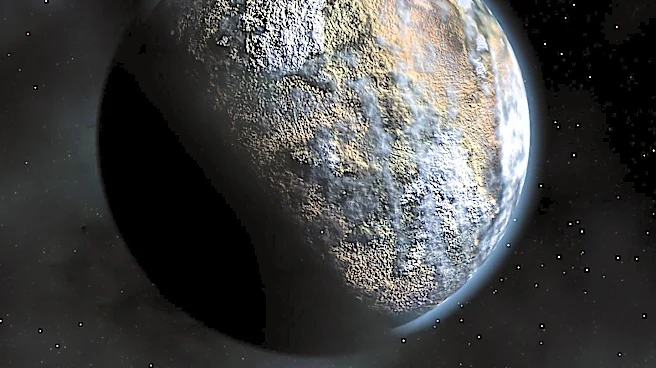
Scientists at the University of Washington in Seattle have developed a computer model simulating a lifeless Earth, which could significantly advance the search for alien life on exoplanets. The model, led by astronomer Samantha Gilbert-Janizek and building
upon previous work by Associate Professor Rory Barnes, integrates Earth's core, mantle, crust, surface, and atmosphere, but crucially omits the impact of biological life. This 'dead Earth' model provides a baseline for what an atmosphere would look like without biosignatures—chemical indicators of life such as specific levels of CO2 and oxygen. By comparing observed exoplanet atmospheres to predictions from this model, astrobiologists can better determine if atmospheric compositions are a result of geological processes alone or if they suggest the presence of life. Over 6,000 exoplanets have been discovered, and the focus for life detection is on those with atmospheres capable of supporting liquid water.
Why It's Important?
This new model is a critical tool for astrobiology, offering a more precise method for interpreting atmospheric data from distant exoplanets. Currently, identifying biosignatures is challenging because non-biological processes can sometimes mimic them. By establishing a clear 'no-life' atmospheric profile for Earth-like planets, scientists can more confidently differentiate between abiotic and biotic atmospheric compositions. This could accelerate the discovery of potentially habitable worlds and prioritize which exoplanets warrant further, more intensive study. The ability to rule out life on certain planets based on their atmospheric match to the 'dead Earth' model allows researchers to focus resources on more promising candidates, thereby making the search for extraterrestrial life more efficient and targeted. This development has profound implications for humanity's understanding of its place in the universe and the prevalence of life beyond Earth.
What's Next?
The University of Washington team plans to fine-tune this model to study other rocky planets. As new exoplanets are discovered and their atmospheric characteristics are observed, scientists will input these parameters into Gilbert-Janizek's model. If the model's predicted atmosphere closely matches the observed one, it would suggest the absence of life on that exoplanet, allowing astrobiologists to move on to other targets. Conversely, a significant discrepancy between the observed and modeled atmospheres would indicate that biological processes might be shaping the planet's atmosphere, making it a prime candidate for further investigation into potential alien life. This iterative process of modeling and observation will refine the search for life, guiding future missions and telescopic observations.
Beyond the Headlines
The development of a 'lifeless Earth' model touches upon fundamental questions about the definition of life and the unique conditions that fostered it on our planet. It highlights the intricate interplay between geological processes and biological activity in shaping a planet's environment. This research also underscores the scientific community's commitment to rigorous, evidence-based approaches in the search for extraterrestrial life, moving beyond speculation to empirical analysis. The ethical implications of discovering alien life, and how humanity might react, are also subtly brought to the forefront, as this model provides a pathway to potentially confirming such a monumental discovery. It represents a step towards understanding not just alien life, but also the delicate balance that sustains life on Earth.