
What's Happening?
Astronomers at the University of North Carolina at Chapel Hill have contributed to the study of the longest-lasting gamma-ray burst ever observed, known as GRB 250702B. This cosmic explosion lasted nearly
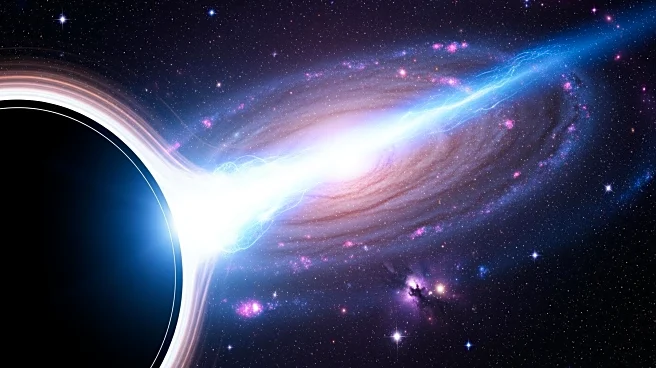
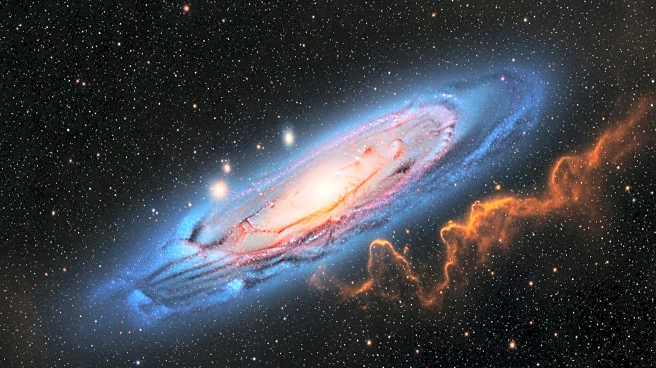
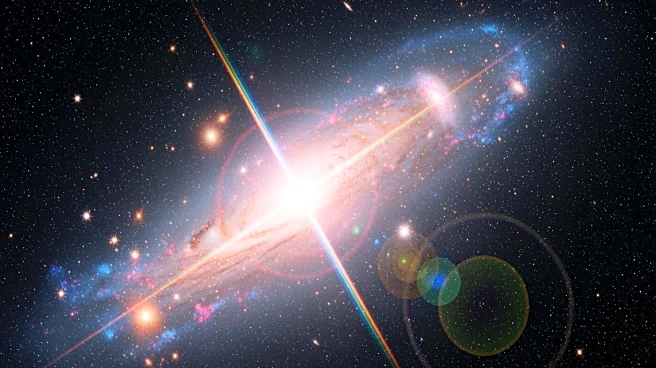
seven hours, challenging existing models of gamma-ray bursts, which typically last only seconds or minutes. The event was detected by space-based observatories, and subsequent observations were conducted using some of the world's largest ground-based telescopes. The data collected suggests several possible origins for the burst, including the collapse of a massive star, the collision of exotic stellar remnants, or a star being torn apart by a black hole. However, the exact cause remains uncertain. The burst originated from a distant, massive galaxy full of dust, which blocked visible light and allowed only infrared and high-energy emissions to be detected.
Why It's Important?
The study of GRB 250702B is significant as it provides a rare opportunity to explore the universe's most extreme environments. Gamma-ray bursts are among the largest explosions in the universe, and understanding them can offer insights into conditions where matter moves at nearly the speed of light, densities exceed atomic nuclei, and gravity can warp spacetime. These bursts also play a crucial role in dispersing heavy elements essential for life across the cosmos. The findings from this event could serve as a benchmark for future research, helping astronomers determine whether similar explosions match GRB 250702B's properties or represent different phenomena. This research contributes to the broader understanding of cosmic events and their implications for the universe's evolution.
What's Next?
Future research will focus on determining the exact cause of GRB 250702B and exploring its implications for understanding gamma-ray bursts. Astronomers will continue to study similar events to see if they align with the properties of GRB 250702B or if they represent new types of cosmic phenomena. The data collected from this event will be used to refine models of gamma-ray bursts and improve predictions about their origins and impacts. As technology advances, researchers will have more tools to investigate these powerful explosions and their role in the universe.
Beyond the Headlines
The study of GRB 250702B highlights the importance of international collaboration in astronomy, as data from various observatories worldwide contributed to the findings. It also underscores the need for continued investment in advanced telescopes and space-based observatories to capture and analyze cosmic events. The research may lead to new insights into the formation and evolution of galaxies, as well as the distribution of elements necessary for life. Additionally, understanding gamma-ray bursts can inform theories about the universe's expansion and the behavior of matter under extreme conditions.