



What's Happening?
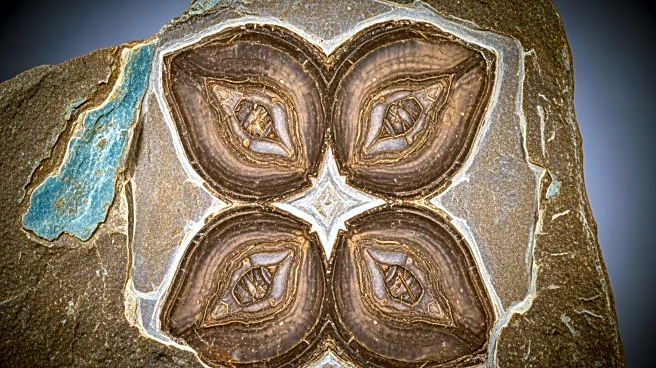
Recent fossil discoveries from the Cambrian period have unveiled that some of the earliest known vertebrates, specifically myllokunmingids, possessed four eyes. This finding, published in Nature, highlights that these ancient fish had two lateral eye-like
structures and a central structure resembling the pineal complex found in modern vertebrates. The study analyzed ten fossil specimens from China, revealing the presence of four eyes in these 518 million-year-old fishes. The research team used advanced techniques such as scanning electron microscopy and transmission electron microscopy to identify melanin-bearing melanosomes in the central structure, which are similar to those found in the eyes of both fossil and living vertebrates. This discovery suggests that the pineal complex in these early vertebrates may have functioned similarly to camera-type eyes, providing a more complex visual function than previously understood.
Why It's Important?
The discovery of four-eyed vertebrates from the Cambrian period provides significant insights into the evolutionary history of vertebrate visual systems. Understanding the presence and function of the pineal complex in these ancient species could reshape current theories about the development of sensory organs in vertebrates. This finding suggests that the pineal complex may have originally had a more complex visual function, potentially influencing how vertebrates adapted to their environments. The presence of additional eyes could have offered these early vertebrates an evolutionary advantage, such as enhanced ability to detect predators, which may have been crucial for survival in the Cambrian ecosystem. This research not only deepens our understanding of vertebrate evolution but also highlights the intricate evolutionary pathways that have led to the diversity of sensory systems observed in modern species.
What's Next?
Further research is likely to focus on exploring the evolutionary pathways that led to the development of the pineal complex and its transformation from a visual organ to a light-sensing and hormone-producing structure in modern vertebrates. Scientists may also investigate other fossil specimens to determine if similar structures existed in other early vertebrate species, which could provide additional evidence of the evolutionary significance of the pineal complex. Additionally, this discovery may prompt a reevaluation of the role of sensory organs in the survival and adaptation of early vertebrates, potentially leading to new insights into the evolutionary pressures that shaped the development of complex visual systems.
Beyond the Headlines
The implications of this discovery extend beyond evolutionary biology, touching on broader questions about the nature of sensory perception and adaptation in living organisms. The study of ancient vertebrates with complex visual systems could inform current research on sensory organ development and function, offering potential applications in fields such as neuroscience and bioengineering. Moreover, understanding the evolutionary history of sensory systems may provide valuable perspectives on how organisms adapt to changing environments, which is increasingly relevant in the context of current environmental challenges.