
What's Happening?
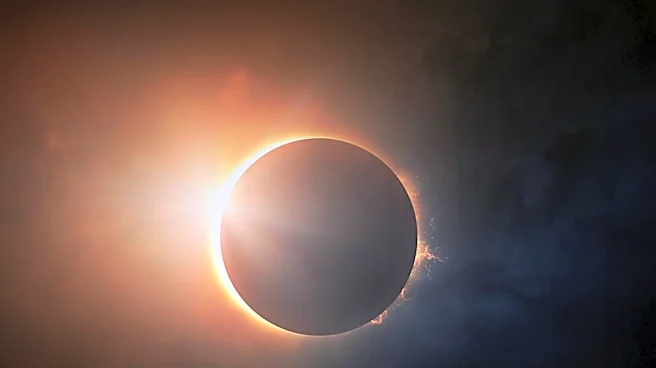
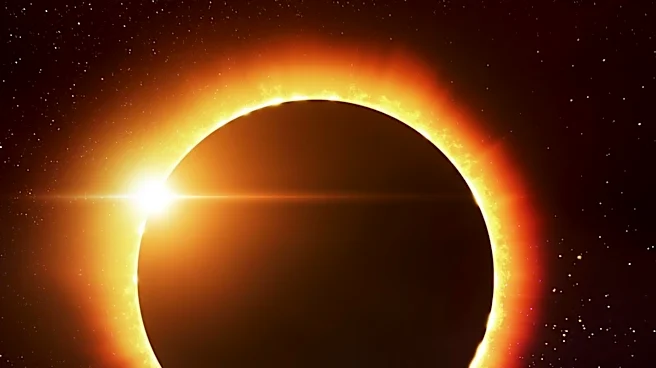
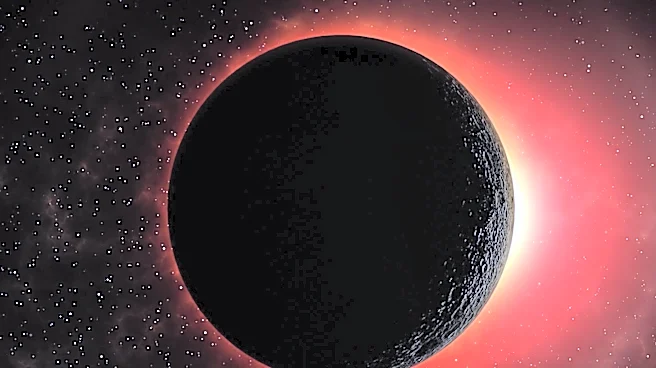
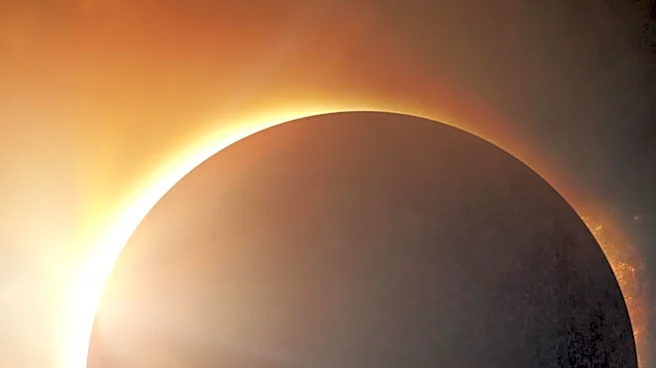
The total solar eclipse on August 12, 2026, presents an unusual visual phenomenon where its path appears to reverse direction on maps. Typically, solar eclipses move from west to east due to the moon and Earth's counterclockwise rotation. However, this
eclipse's path seems to start in northern Siberia and move towards eastern Greenland, creating an illusion of east-to-west movement. This apparent reversal is a result of the eclipse's path crossing near the North Pole, combined with the effects of Earth's rotation and the tilt of both Earth's axis and the moon's orbit. On flat maps, this path appears to curve back on itself, although the shadow never actually changes direction. The eclipse's path will sweep over the Arctic in a broad curve, creating this visual anomaly.
Why It's Important?
Understanding the geometric and astronomical principles behind this eclipse's path is crucial for both scientific and educational purposes. It highlights the complexities of celestial mechanics and the impact of Earth's shape and rotation on our perception of astronomical events. For educators and scientists, this provides an opportunity to explain these concepts to the public, enhancing scientific literacy and interest in astronomy. Additionally, the unique path of this eclipse offers a rare chance for researchers to study solar and atmospheric phenomena in the Arctic region, contributing to our understanding of these environments. The event also underscores the importance of accurate map projections in representing global phenomena.
What's Next?
As the eclipse date nears, educational campaigns and public outreach efforts will likely increase to explain the eclipse's path and the science behind it. Scientists may plan expeditions to the Arctic to observe the eclipse and conduct research, taking advantage of the unique conditions. Media coverage will aim to clarify the visual illusion for the public, ensuring accurate understanding and appreciation of the event. Additionally, preparations for safe viewing practices will be emphasized, with reminders about the importance of using proper eye protection during the partial phases of the eclipse.