
What's Happening?
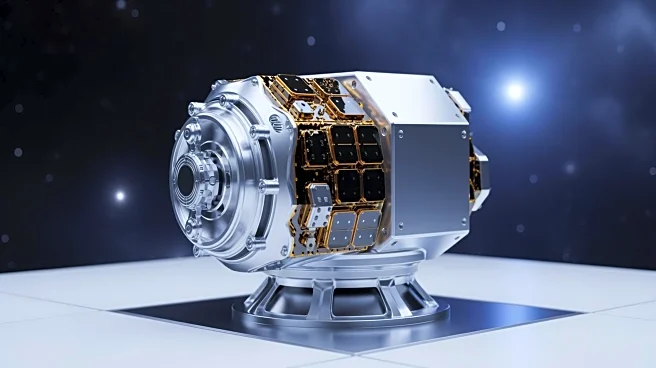
NASA's Libera instrument, designed to maintain the global data record of Earth's radiation budget, has successfully completed comprehensive environmental testing. This milestone included thermal vacuum
tests simulating space conditions. Libera will be part of the Joint Polar Satellite System-4 (JPSS-4), a collaboration between NASA and NOAA, scheduled for launch in 2027. Developed by the University of Colorado Boulder's Laboratory for Atmospheric and Space Physics, Libera continues the data record of Earth's radiation budget, following the Clouds and the Earth's Radiant Energy System (CERES) instruments. The instrument will be the fifth and final one delivered to Northrop Grumman for installation onto JPSS-4.
Why It's Important?
The successful testing and upcoming deployment of the Libera instrument are crucial for continuing the long-term monitoring of Earth's radiation budget, which is vital for understanding climate dynamics and informing weather forecasting and agricultural planning. This data supports strategic planning and risk assessments by the U.S. government and commercial industries. The collaboration between NASA and NOAA highlights the importance of maintaining continuity in Earth science measurements, which are essential for addressing climate change and its impacts on global and national scales.
What's Next?
With the completion of testing, the Libera instrument will be integrated into the JPSS-4 satellite, with a launch targeted for 2027. Once in orbit, it will be named NOAA-22. The data collected by Libera will continue to inform climate models and support various applications, including weather forecasting and agricultural planning. The collaboration between NASA and NOAA will ensure the seamless continuation of critical Earth science data collection.