




What's Happening?
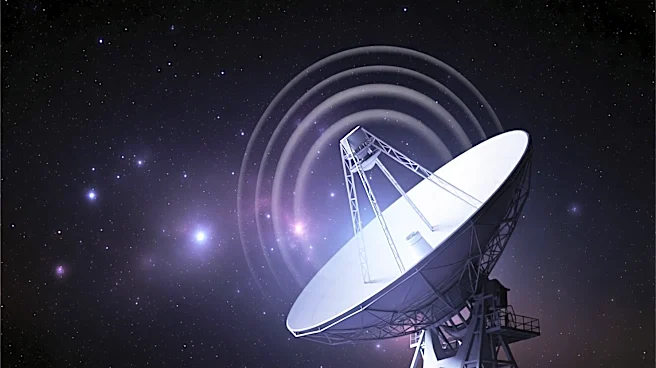
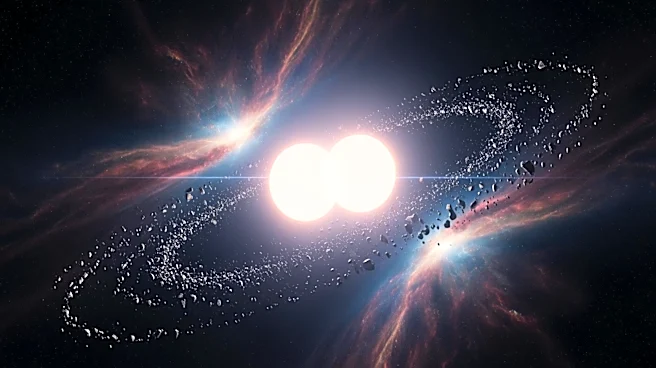
Astronomers have identified the source of a new type of repeating radio burst, known as ASKAP J1745, originating from a pair of stars spiraling around each other. These bursts, classified as long-period transients, have puzzled scientists due to their
slow repetition rates. The discovery was made using multiple telescopes observing different wavelengths, including radio and X-ray. ASKAP J1745 is the first of its kind to be identified as a 'cataclysmic variable,' a system where a white dwarf star accretes material from a companion star. This finding provides a 'Rosetta stone' for understanding other long-period transients, offering insights into the mechanisms behind these mysterious cosmic signals.
Why It's Important?
The identification of ASKAP J1745 as a cataclysmic variable is crucial for understanding the origins of long-period transients, which have been a mystery in astrophysics. By studying these systems, scientists can gain insights into extreme physical processes, such as plasma flows and magnetic fields, under conditions that cannot be replicated on Earth. This discovery also enhances our understanding of binary star systems and the interactions between stars, contributing to the broader field of stellar evolution and dynamics.