





What's Happening?
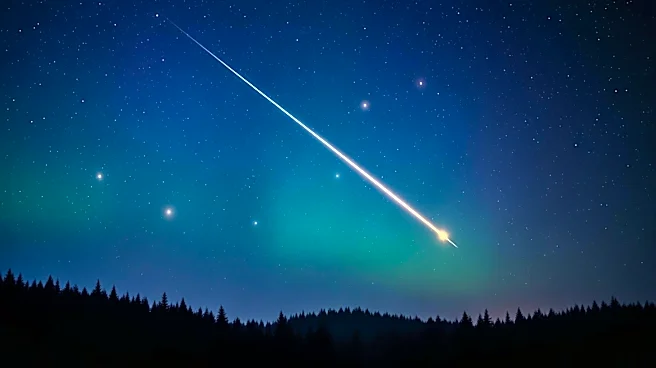
A bright meteor lit up the night sky over the Pacific Northwest on April 29, capturing the attention of over 150 observers across Oregon, Washington, and British Columbia. According to the American Meteor Society, the meteor was traveling southwest at an estimated
speed of 66,000 miles per hour before disintegrating over the Pacific Ocean. Witnesses reported seeing vibrant flashes of orange, blue, and green as the meteor broke apart, colors that are attributed to its chemical composition and interaction with Earth's atmosphere. The event was not linked to any known meteor shower, such as the ongoing Lyrid meteor shower, and is considered a sporadic meteor. The American Meteor Society is collecting reports and video footage to analyze the meteor's trajectory and composition further.
Why It's Important?
The meteor event highlights the ongoing interest and engagement in astronomical phenomena among the public and scientific communities. Such events provide valuable data for researchers studying meteors' paths and compositions, contributing to a broader understanding of these celestial occurrences. For the public, witnessing a meteor can spark interest in space science and astronomy, potentially inspiring future generations of scientists. Additionally, the event underscores the importance of organizations like the American Meteor Society in facilitating citizen science and data collection, which are crucial for advancing scientific knowledge.
What's Next?
The American Meteor Society will continue to gather and analyze data from this event, encouraging those who witnessed the meteor or captured it on video to submit their observations. This information will help researchers refine their understanding of the meteor's characteristics and its journey through the atmosphere. As Earth continues to pass through debris from celestial bodies like Halley's Comet, more meteor showers are expected, offering further opportunities for observation and study.