










What's Happening?
Tanzania is poised for significant growth in its energy and chemicals sectors, driven by its Fourth Five-Year Development Plan (FYDP IV) from 2026 to 2031. The plan aims to transform Tanzania into a regional power hub with 15,000 MW of installed capacity
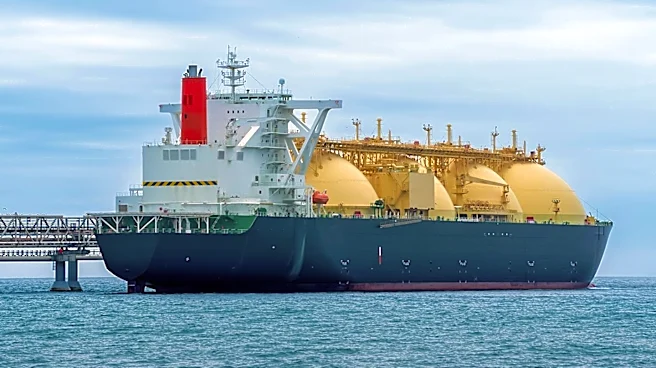
by 2031 and universal household connectivity by 2050. Central to this transformation is the development of liquefied natural gas (LNG) infrastructure, leveraging Tanzania's estimated 57 trillion cubic feet of proven gas reserves. The $42 billion Lindi LNG project is a key component, expected to double pipeline capacity by 2031 and position Tanzania as a major global exporter. This development is anticipated to trigger a ripple effect across the economy, attracting investment in power generation, manufacturing, logistics, and supporting infrastructure.
Why It's Important?
The expansion of Tanzania's LNG infrastructure is crucial for the country's economic development and energy security. By increasing its energy capacity and transitioning to cleaner energy sources, Tanzania can reduce its reliance on biomass and LPG for household cooking and support industrial growth. The Lindi LNG project is expected to attract significant foreign investment, boosting the country's GDP and creating jobs. Additionally, the development of LNG infrastructure will enhance Tanzania's position in the global energy market, potentially leading to increased exports and improved trade balances. The integration of advanced technologies, such as those provided by Schneider Electric, will further enhance the efficiency and sustainability of Tanzania's energy sector.
What's Next?
As Tanzania progresses with its LNG expansion, early-stage developments are likely to attract further investment in related sectors. New thermal power stations are being considered, particularly in the southern regions, with gas as a primary fuel source. The involvement of technology partners like Schneider Electric will be critical in ensuring the successful implementation of advanced systems for power generation, transmission, and industrial operations. The focus will be on integrating electrification, automation, and energy management solutions to support the growing energy and industrial markets. As these projects advance, Tanzania is expected to emerge as one of Africa's fastest-growing energy and industrial markets.
Beyond the Headlines
The development of Tanzania's LNG infrastructure has broader implications for the region's energy landscape. By positioning itself as a regional power hub, Tanzania can play a pivotal role in addressing energy deficits in neighboring countries. The shift towards cleaner energy sources also aligns with global efforts to combat climate change, potentially attracting international support and collaboration. Furthermore, the integration of digital technologies and IoT solutions in the LNG sector can serve as a model for other African nations seeking to modernize their energy infrastructure. This transformation could lead to long-term economic resilience and sustainable development across the region.