





What's Happening?
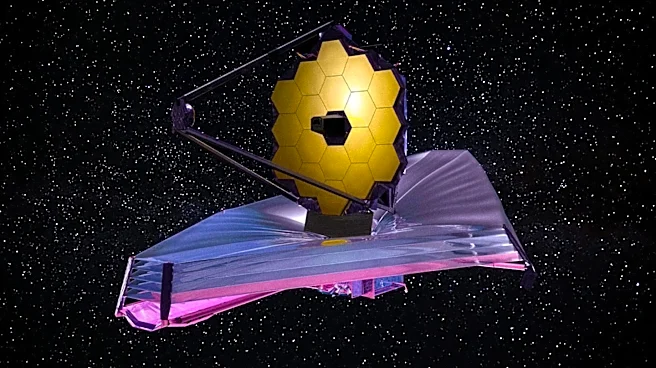
Observations from NASA's James Webb Space Telescope have revealed mysterious 'little red dots' in a region of the universe dating back hundreds of millions of years after the Big Bang. Max Planck Institute astrophysicist Sunmyon Chon and his colleagues
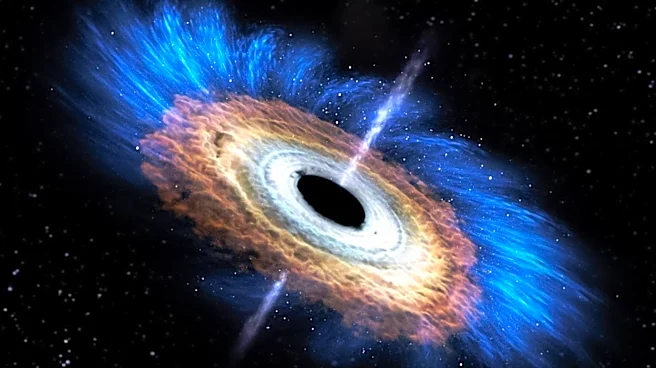
propose in a new paper published in 'Nature' that these red dots could represent the earliest stages of supermassive black holes. Their simulations suggest that rapidly forming black holes could emit light while accreting material, appearing as these 'seeds' detected by the James Webb. These newly formed 'overmassive' black holes are theorized to rapidly develop dense, optically thick disks, producing broad hydrogen-alpha emission comparable to what is seen in the red dots. Chon's team posits that these black holes could evolve into 'overmassive' quasars, which are extremely bright celestial objects powered by gas being absorbed by a supermassive black hole, and could be the progenitors of today's supermassive black holes within less than a billion years.
Why It's Important?
This research offers a potential explanation for one of the universe's enduring mysteries: the rapid formation of supermassive black holes in the early cosmos. If confirmed, the 'little red dots' would provide direct observational evidence for the initial growth phases of these colossal objects, which are found at the center of most galaxies, including our own Milky Way. Understanding how supermassive black holes formed and grew so quickly after the Big Bang is crucial for comprehending galaxy evolution and the large-scale structure of the universe. This discovery could reshape current cosmological models and theories about the early universe, influencing future research directions in astrophysics. It also highlights the unprecedented capabilities of the James Webb Space Telescope in observing the most distant and ancient parts of the cosmos, pushing the boundaries of astronomical discovery.
What's Next?
The scientific community is still working to reach a consensus on the nature of these 'little red dots.' While Chon's team presents a compelling hypothesis, other explanations, such as emerging galaxies or different stages of regular black hole evolution, are also being considered. Future research will involve more detailed simulations and further observations from the James Webb Space Telescope to gather additional data and refine existing theories. Scientists will aim to characterize the properties of these red dots more precisely, looking for specific spectral signatures or evolutionary patterns that could definitively link them to nascent supermassive black holes. The ongoing debate and continued investigation will be vital in solidifying our understanding of the early universe and the origins of its most massive structures.
Beyond the Headlines
The identification of 'little red dots' as potential seeds of supermassive black holes delves into the fundamental questions of cosmic origins and evolution. It challenges our understanding of how quickly massive structures could have formed after the Big Bang, potentially indicating a more rapid and efficient growth mechanism than previously thought. This discovery also underscores the dynamic and often violent nature of the early universe, where immense gravitational forces were at play in shaping galaxies. The use of the James Webb Space Telescope, with its advanced infrared capabilities, exemplifies the critical role of cutting-edge technology in pushing the frontiers of scientific exploration. The ongoing process of scientific inquiry, with competing hypotheses and the need for further evidence, showcases the iterative and self-correcting nature of the scientific method in unraveling the universe's deepest secrets.