




What's Happening?
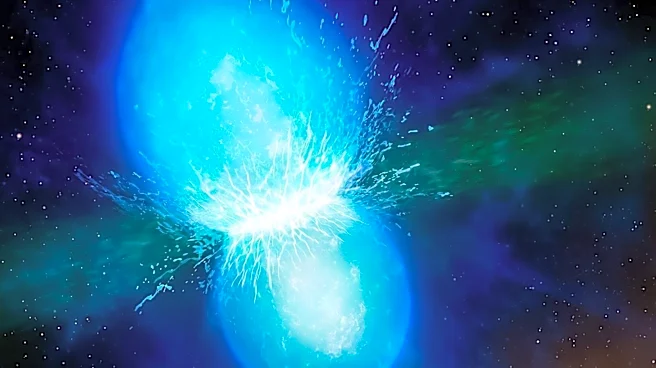
Astronomers have detected an unprecedented gamma-ray burst (GRB) designated GRB 220706A, which exhibited X-ray flaring for approximately 27 days following its initial explosion. This duration significantly surpasses the previous record for GRB afterglows,
which was around six days. Benjamin Gompertz, a study team member from the University of Birmingham, highlighted that this extended activity indicates an ongoing active process, a phenomenon previously unobserved in such a prolonged manner. GRB 220706A was initially spotted on July 6, 2022. The scientific community is particularly intrigued because the exact nature of the central engine driving this exceptionally long outburst remains unknown, making it a compelling subject for further research.
Why It's Important?
This discovery challenges existing models of gamma-ray bursts and stellar evolution. GRBs are among the most powerful cosmic explosions, typically linked to the collapse of massive stars (long-duration GRBs) or the collision of neutron stars (short-duration GRBs). GRB 220706A is classified as an ultra-long GRB, a rare category where the power source remains active for an extended period. The prolonged flaring suggests that the underlying mechanism might involve a much larger star than previously thought, possibly a blue supergiant, or a different type of remnant like a magnetar. Understanding these ultra-long GRBs could provide crucial insights into the extreme physics of stellar death and the formation of black holes and magnetars, potentially refining our understanding of the early universe's stellar populations.
What's Next?
Researchers plan to continue studying GRB 220706A to unravel the mystery of its central engine. The team is considering possibilities such as a magnetar, a neutron star with an exceptionally powerful magnetic field, or interactions between the GRB jet and dense material ejected by the parent star. The detection of a second ultra-long GRB with an unusually bright supernova, similar to GRB 111209A, strengthens the hypothesis that these events might originate from a distinct population of stars. Future missions, such as the Einstein Probe, which is more sensitive to X-rays, are expected to play a crucial role in detecting more ultra-long GRBs. This will provide additional data points necessary to develop more comprehensive theoretical models that can account for such prolonged cosmic power sources.
Beyond the Headlines
The difficulty in detecting such long-lasting GRBs is partly due to the limitations of current satellite technology, as most GRB-detecting satellites are in low Earth orbit, leading to periodic blockages. This suggests that many similar events might have gone unnoticed. The existence of GRB 220706A pushes the boundaries of our astrophysical knowledge, implying that the universe may harbor more extreme and prolonged phenomena than previously conceived. The ongoing quest to understand these cosmic explosions not only advances fundamental physics but also highlights the continuous evolution of observational astronomy and the need for more sophisticated instruments to capture the full spectrum of cosmic events.