





What's Happening?
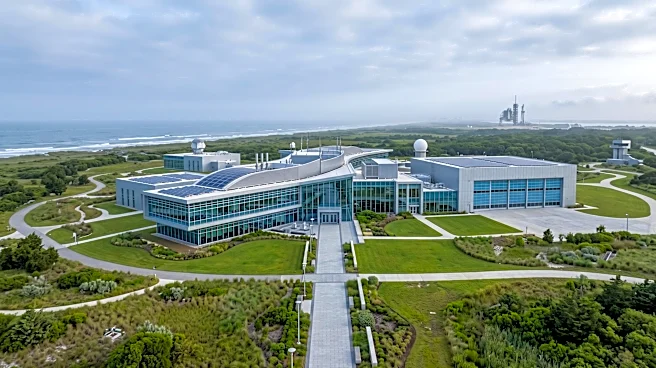
Governor Abigail Spanberger announced that the Commonwealth of Virginia has submitted a proposal to NASA to establish the United States Space Academy in Hampton, Virginia. The proposed academy would utilize a unified campus spanning over 600 acres at NASA Langley
Research Center and Fort Monroe, with a satellite campus at the Virginia Spaceport Authority's Mid-Atlantic Regional Spaceport (MARS) at NASA's Wallops Flight Facility. The plan aims to welcome approximately 300 cadets by 2028, leveraging existing academic, residential, and laboratory facilities. A statewide consortium of universities, led by Virginia Polytechnic Institute and State University, would support a curriculum covering aerospace engineering, data science, cybersecurity, and other related fields. The proposal has garnered full support from Virginia's congressional delegation, including Senators Mark Warner and Tim Kaine, and numerous representatives.
Why It's Important?
Establishing the United States Space Academy in Virginia would significantly bolster the state's position as a leader in aerospace innovation and national defense. This initiative promises to create new educational and training opportunities, fostering the next generation of scientists, engineers, and space explorers. For the U.S., the academy would be crucial in preparing future leaders across the aerospace sector, ensuring American interests are advanced in space exploration and defense. The proposal highlights Virginia's existing robust aerospace industry, military and intelligence assets, and strong higher education system, making it a strategic location. Economically, it would bring substantial investment, job creation, and further solidify Virginia's role in the national space enterprise, attracting talent and resources to the region.
What's Next?
Virginia's proposal is a preliminary, non-binding submission to NASA, which had issued a Request for Information for a civilian federal academic institution focused on space. The next phase will involve NASA's evaluation of proposals from various states. If Virginia's bid is successful, further detailed planning and securing necessary federal, state, local, institutional, and governing-body approvals will be required. The Commonwealth is prepared to work with NASA to rapidly scale the academy, aiming to train the first class of cadets by 2028. Continued bipartisan support from the congressional delegation will be crucial in advocating for Virginia's selection and securing the necessary federal resources to bring this world-class institution to fruition in Hampton Roads.
Beyond the Headlines
The establishment of a United States Space Academy in Virginia carries profound long-term implications beyond its immediate educational and economic benefits. It signifies a national commitment to maintaining leadership in space, a domain increasingly critical for national security, scientific advancement, and economic prosperity. Ethically, the academy would instill a sense of civic responsibility and public service in future aerospace leaders, shaping the values that guide space exploration and utilization. Culturally, it could inspire a new generation to pursue STEM fields, fostering a deeper societal engagement with space science and technology. Legally, the academy's operations and curriculum would need to navigate complex regulations related to space law, national security, and international cooperation, particularly as space becomes more contested. This initiative represents a strategic investment in human capital, aiming to secure America's future in the evolving space frontier.