








What's Happening?
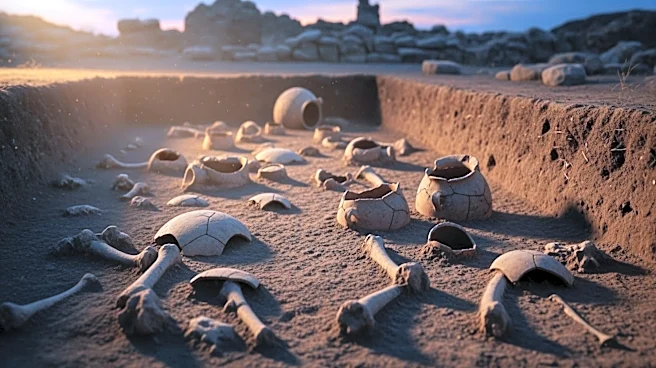
Archaeologists have discovered a mass grave in Jerash, Jordan, containing hundreds of plague victims from the sixth century. This site is the first biomolecularly verified plague burial associated with the Plague of Justinian in the Eastern Mediterranean.
The grave, located in the ancient city's hippodrome, contains approximately 230 individuals buried rapidly over a short period. DNA analysis confirmed the presence of Yersinia pestis, the bacterium responsible for the bubonic plague. The findings provide new insights into the demographic and social impacts of the plague on urban communities during this period.
Why It's Important?
This discovery is crucial for understanding the historical impact of pandemics on ancient societies. The Jerash site offers a rare glimpse into how the Plague of Justinian affected a thriving Byzantine city, highlighting the vulnerability of urban centers to infectious diseases. The research also sheds light on the mobility and diversity of populations in the region, as isotopic analysis revealed a wide range of geographic origins among the victims. These findings contribute to the broader understanding of how pandemics influence social structures and population dynamics, offering parallels to modern-day public health challenges.
Beyond the Headlines
The Jerash discovery challenges previous assumptions about population movement in the Byzantine Levant. The isotopic diversity among the plague victims suggests that people from various regions converged in Jerash, possibly due to trade or migration. This highlights the interconnectedness of ancient societies and the role of urban centers as melting pots of cultural and genetic diversity. The study also emphasizes the importance of integrating biological and archaeological evidence to reconstruct historical events, providing a more comprehensive understanding of past pandemics and their societal impacts.