



What's Happening?
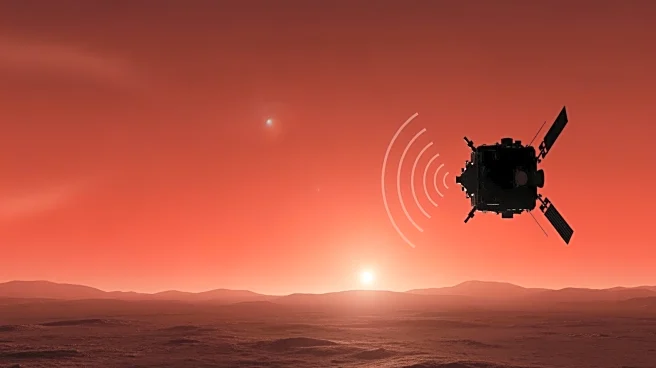
NASA's Mars Atmosphere and Volatile Evolution (MAVEN) spacecraft has experienced a communication failure, with no telemetry received since December 4th. The spacecraft, which orbits Mars in a 3.6-hour elliptical path, failed to reconnect with ground stations
after emerging from behind the planet. A partial tracking data segment from December 6th indicated an unexpected spin and possible trajectory change. The anomaly is under investigation by NASA's Planetary Science Division, with Alana Johnson, a Senior Communications Specialist, confirming ongoing efforts to address the issue. The situation is complicated by Mars' current position behind the Sun, which typically results in extended communication blackouts.
Why It's Important?
The MAVEN mission, launched in 2013, plays a crucial role in understanding Mars' atmospheric loss and its interaction with solar winds. The spacecraft's findings have been instrumental in studying the planet's climate history and atmospheric changes. The potential loss of MAVEN could impact ongoing and future Mars research, particularly as it was set to provide complementary data with upcoming missions like the ESCAPADE orbiters. The mission's termination was already under consideration due to budget constraints, highlighting the financial and scientific challenges faced by NASA in maintaining long-term space exploration projects.
What's Next?
NASA teams are working to resolve the communication issue, but efforts are hindered by Mars' solar conjunction, which will last until January 9, 2026. This period typically involves planned communication blackouts, complicating recovery attempts. The outcome of these efforts will determine MAVEN's future and its ability to continue contributing to Mars research. The scientific community and stakeholders are likely to closely monitor developments, given the mission's significance in understanding Mars' atmospheric evolution.