






What's Happening?
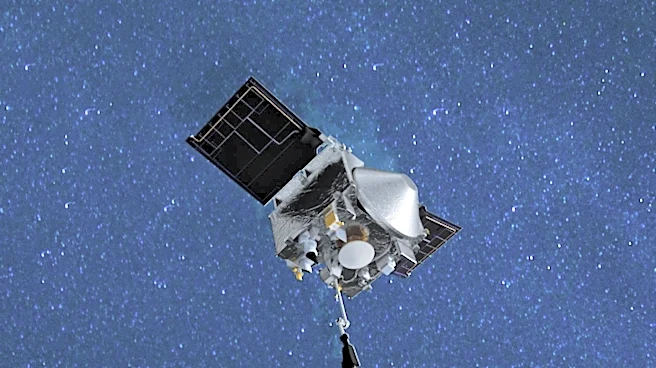
Samples from asteroid Bennu, collected by NASA's OSIRIS-REx mission, have provided scientists with crucial insights into the asteroid's formation and the early composition of the solar system. The study, reported by Space.com and UNN, indicates that Bennu originated
at the boundary between the hot and cold regions of the protoplanetary disk approximately 4.5 billion years ago. Maria Schönbächler, a professor of isotope geochemistry at ETH Zurich, highlighted that Bennu offers one of the best perspectives into the initial mixture of chemical elements from which terrestrial planets eventually formed. The OSIRIS-REx mission studied Bennu from 2018 to 2021 and delivered about 120 grams of its soil to Earth on September 23, 2023. Portions of this unique sample were distributed to laboratories worldwide, including Schönbächler's team, which analyzed isotopes of iron, titanium, and chromium. The analysis revealed that Bennu's material was well mixed and its composition closely resembles the average composition of the protoplanetary disk from which Earth and other planets were built.
Why It's Important?
This research is profoundly important for understanding the origins of Earth and other terrestrial planets. By studying the pristine material from Bennu, scientists can reconstruct the conditions and chemical makeup of the early solar system 4.5 billion years ago. The similarity in composition between Bennu, asteroid Ryugu (from which Japan's Hayabusa2 mission collected samples), and rare CI chondrite meteorites suggests that these celestial bodies may have formed in the same region of the early solar system. This consistency provides a more unified picture of the initial building blocks available for planet formation. The well-mixed nature of Bennu's material indicates a dynamic early solar system where elements were thoroughly distributed. This understanding helps refine models of planetary accretion and differentiation, offering clues about the processes that led to the diverse compositions of planets in our solar system. Ultimately, these findings contribute to a deeper comprehension of how our own planet, with its unique conditions for life, came into existence.
What's Next?
The ongoing analysis of Bennu's samples will continue to yield new discoveries about the early solar system. Scientists in various laboratories around the world will further investigate the asteroid's mineralogy, organic compounds, and isotopic ratios to gain a more comprehensive understanding of its history and its implications for planetary science. Future research will likely involve comparing Bennu's data with samples from other asteroids and meteorites to identify commonalities and differences, thereby refining models of solar system evolution. The insights gained from Bennu could also inform future asteroid sample return missions, guiding the selection of targets that promise to reveal even more about cosmic origins. The data will also be crucial for understanding the potential resources available on asteroids and for developing strategies for planetary defense against potentially hazardous objects.
Beyond the Headlines
The study of asteroid Bennu transcends mere scientific curiosity; it offers a tangible connection to the very beginnings of our solar system. The ability to hold and analyze material that predates Earth's formation provides an unprecedented opportunity to understand the raw ingredients from which our world, and potentially life itself, emerged. This research touches upon fundamental questions about our place in the universe and the commonality of planetary formation processes. The fact that Bennu's composition is so similar to other primitive bodies suggests a shared cosmic heritage, implying that the building blocks for planets might be universally distributed. This could have implications for astrobiology, as it suggests that the chemical precursors for life might be widespread throughout the galaxy. The OSIRIS-REx mission exemplifies the power of international scientific collaboration and advanced space exploration in unraveling the mysteries of the cosmos, pushing the boundaries of human knowledge about our origins.