



What's Happening?
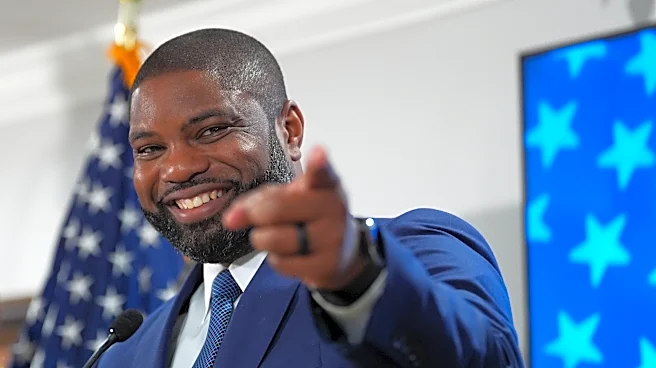
Byron Donalds, a Republican candidate for governor, has received substantial financial contributions from wealthy donors and special interest groups, totaling over $93 million for his campaign. A political committee in California, 'The People Versus the
Powerful,' which is entirely financed by Airbnb, contributed $1 million to 'Friends of Byron Donalds,' a separate committee with no legal limits on spending. Other significant donors include hedge fund billionaire Ken Griffin, who gave $10 million, and right-wing billionaires Jeff Yass and Richard Uihlein, contributing $7.5 million and $2 million, respectively. The Seminole Tribe, with gambling interests in the state, invested $3 million, while casino mogul Steve Wynn and Thomas Peterffy, a billionaire close to President Trump, each gave $1 million. The private prison company GEO Group has also contributed $1.5 million. Additionally, energy companies like NextEra Energy, Duke Energy, and Tampa Electric have made contributions, as have data center interests, which have given over $1.2 million to Donalds' campaign.
Why It's Important?
The significant influx of money from wealthy individuals and special interest groups into Byron Donalds' gubernatorial campaign highlights the pervasive influence of large financial contributions in U.S. politics, particularly in state-level elections. The use of separate political committees, like 'Friends of Byron Donalds,' which are not subject to the same donation limits as official campaign accounts, allows for unlimited spending and raises concerns about transparency and accountability. This trend suggests that the voices of ordinary citizens may be overshadowed by the financial power of corporations and billionaires, potentially leading to policies that favor well-funded interests over public welfare. For instance, Airbnb's contribution is seen as an effort to protect the status quo regarding short-term rental regulations, which many local officials oppose. Similarly, contributions from energy companies and data center developers could influence decisions on utility regulation and land use, impacting environmental policies and local communities. This dynamic underscores the ongoing debate about campaign finance reform and the role of money in shaping political outcomes.
What's Next?
The substantial financial backing for Byron Donalds' campaign is likely to intensify the debate surrounding campaign finance laws and the influence of special interests in Florida politics. As the 2026 gubernatorial election approaches, it is anticipated to be one of the most expensive in the state's history. This could prompt increased scrutiny from media and watchdog groups regarding the sources and uses of campaign funds. There may also be renewed calls for legislative action to close loopholes that allow unlimited contributions to political committees, potentially reigniting discussions about constitutional amendments to regulate campaign spending, as proposed by the late U.S. Supreme Court Justice Paul Stevens. The outcome of the election could significantly impact policy decisions related to short-term rentals, energy regulation, and data center development, reflecting the priorities of the major donors. Furthermore, other candidates in the race may face pressure to secure similar levels of funding to remain competitive, perpetuating the cycle of big money in politics.
Beyond the Headlines
The extensive financial contributions to Byron Donalds' campaign reveal a deeper systemic issue within U.S. democracy: the tension between free speech and fair elections. While the Supreme Court has upheld the right to unlimited independent expenditures as a form of free speech, critics argue that this allows wealthy donors and corporations to exert disproportionate influence, effectively turning elections into auctions. This raises fundamental questions about the equitable representation of all citizens and the integrity of the democratic process. The focus on data centers as a new source of significant political contributions also points to emerging economic interests shaping political landscapes, potentially at the expense of environmental concerns or local community needs. The long-term implications include a potential erosion of public trust in government, as citizens may perceive their elected officials as beholden to financial backers rather than the electorate. Addressing these challenges requires a comprehensive re-evaluation of campaign finance regulations and a broader societal commitment to ensuring that all voices have an equal opportunity to be heard in the political arena.