





What's Happening?
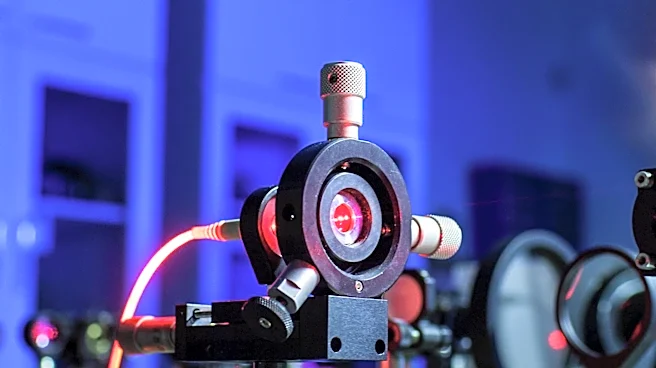
Scientists are investigating a novel approach to controlling mode-locking in lasers, specifically focusing on 'liquid light' systems. This research, detailed in a recent study, maps actively modulated fast-gain ring lasers to fluid dynamics, where the
laser's intensity acts as a constant density and its instantaneous frequency as flow velocity. By applying programmable radio-frequency modulation, which functions as a variable potential landscape, researchers can control this 'flow' of light. This method allows for the design of emitted spectra by manipulating the phase dynamics of the laser. The study derives analytical solutions connecting the applied modulation to the instantaneous frequency and the resulting spectrum, providing experimental evidence using a fast-gain semiconductor laser. This hydrodynamic picture offers a predictive design principle for frequency combs and establishes fast-gain lasers as an accessible, electrically driven platform for non-equilibrium fluids of light. The research highlights how gain and loss sustain the fluid-like behavior, allowing for non-uniform flow at nearly constant density.
Why It's Important?
This research holds significant implications for the development of advanced laser technologies and their applications across various U.S. industries. The ability to precisely design and control frequency combs, which are crucial for applications requiring specific wavelengths with fast tunability, could revolutionize fields such as spectroscopy and optical communications. In spectroscopy, this technology could enable more efficient and accurate analysis by concentrating power on absorption features. For optical communications, it could lead to improved data transmission by allowing power redistribution among channels, potentially increasing bandwidth and efficiency. The establishment of fast-gain lasers as an accessible, electrically driven platform could also reduce the cost and complexity of implementing these advanced laser systems, making them more widely available for research and commercial use. This advancement could foster innovation in photonics, leading to new products and services that rely on highly controlled light sources, benefiting sectors from manufacturing to defense.
What's Next?
The immediate next steps for this research involve further refinement of the hydrodynamic model and exploring its applicability to a wider range of laser systems. Researchers will likely focus on optimizing the programmable radio-frequency modulation techniques to achieve even more precise control over the emitted spectra. Future work may also include investigating the scalability of this approach for industrial applications and integrating these advanced lasers into existing technological frameworks. Collaboration between academic institutions and industry partners could accelerate the transition of this research from laboratory settings to practical deployment. Additionally, the principles derived from this study could inspire new avenues of research into other quantum fluid phenomena and their potential technological exploitation, potentially leading to unforeseen applications in quantum computing or advanced sensing.
Beyond the Headlines
The concept of 'liquid light' extends beyond mere technological advancement, touching upon fundamental aspects of quantum physics and fluid dynamics. This research blurs the lines between classical fluid mechanics and quantum phenomena, offering a unique perspective on how light behaves under specific conditions. The ability to model and control light as a fluid could lead to a deeper understanding of complex systems and emergent properties in physics. Ethically, as with any powerful technology, the development of highly precise and tunable lasers could have dual-use implications, requiring careful consideration of their applications. Culturally, advancements in laser technology often inspire new forms of scientific art and communication, potentially leading to novel ways of visualizing and interacting with light. Long-term, this research contributes to a broader scientific effort to harness quantum effects for practical purposes, potentially paving the way for a new generation of quantum technologies.