







What's Happening?
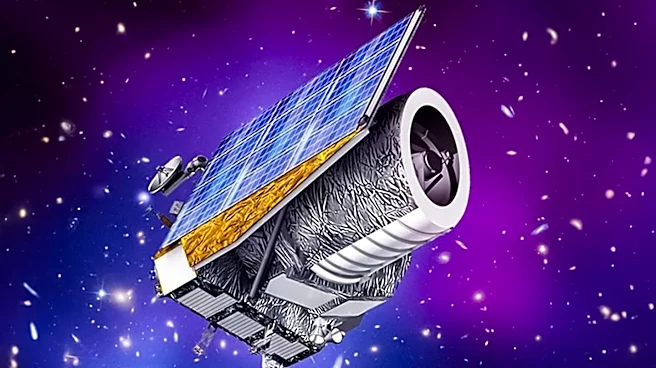
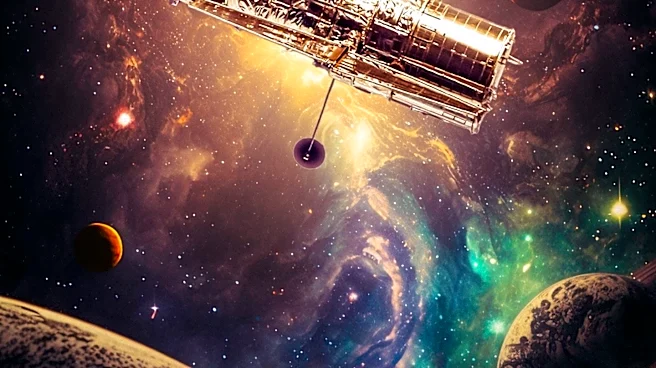
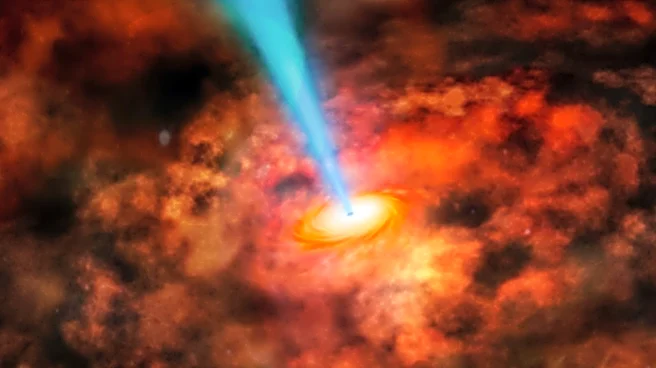
The Euclid space telescope, a collaborative project between the European Space Agency (ESA) and NASA, has made a groundbreaking discovery by identifying 31 of the most ancient known quasars. These quasars, which are extremely bright objects formed around
supermassive black holes, have been detected at vast distances due to their immense brightness. Among these, two quasars are the most ancient ever detected, having formed approximately 670 million years after the Big Bang. The light from these quasars has been traveling to Earth for about 13 billion years, allowing astronomers to observe the Universe as it was shortly after its inception. The findings have been published in the scientific journal Astronomy & Astrophysics. The Euclid mission aims to create a detailed map of billions of galaxies and enhance the understanding of dark energy, which is believed to be causing the accelerated expansion of the Universe.
Why It's Important?
This discovery is significant as it provides insights into the early Universe, particularly the formation of the first galaxies and supermassive black holes. Understanding these ancient quasars can help scientists unravel the mysteries of the Universe's early history and the role of dark energy in its expansion. The data collected by the Euclid telescope will also support future missions, such as NASA's Nancy Grace Roman Space Telescope, which will continue to explore dark energy and the evolution of the Universe. The ability to observe such distant objects challenges current astronomical models and could lead to new theories about the Universe's formation and development.
What's Next?
The Euclid mission will continue to map billions of galaxies, providing a comprehensive view of the Universe's structure and evolution. The data will be crucial for upcoming missions like the Nancy Grace Roman Space Telescope, which aims to further investigate dark energy and its effects on the Universe. As scientists analyze the data from these ancient quasars, they may uncover new information that could redefine our understanding of cosmic history and the fundamental forces shaping the Universe.
Beyond the Headlines
The discovery of these ancient quasars not only enhances our understanding of the Universe's early stages but also highlights the technological advancements in space exploration and observation. The ability to detect such distant objects underscores the importance of international collaboration in scientific research. Furthermore, these findings may inspire future generations of astronomers and physicists to explore the unknown aspects of the cosmos, potentially leading to groundbreaking discoveries in the field of astrophysics.