






What's Happening?
The National Science Foundation (NSF) has awarded a $4.5 million grant to a collaborative project called Diagnostics for Extreme Light (DELIGHT). This funding will support continued research by scientists from six universities across the country, including
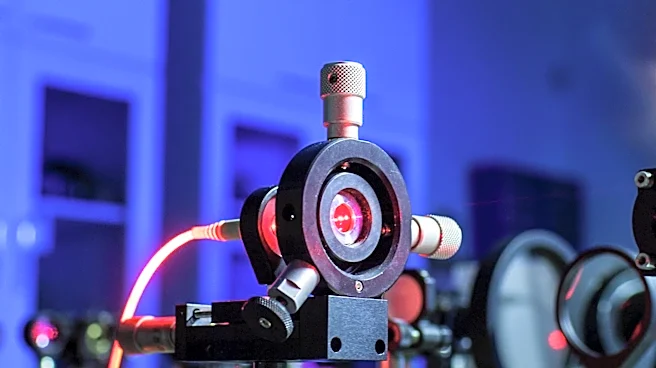
the University of Nevada, Reno. The DELIGHT project focuses not on building lasers, but on measuring the light, particles, and matter generated by some of the world's most powerful lasers. Researchers recently spent four weeks at the University of Michigan, studying the country's highest-intensity laser. Tom White, Physics Department Chair at UNR, described these lasers as capable of generating conditions found at the center of planets, likening them to a billion billion laser pointers focused on one spot for a billionth of a second.
Why It's Important?
This significant NSF grant underscores the importance of fundamental research in extreme light physics for advancing scientific understanding. While immediate real-world applications may not be apparent, the ability to create and study extreme conditions on Earth allows scientists to explore phenomena relevant to astrophysics, material science, and energy research. This type of research can lead to breakthroughs in areas such as fusion energy, advanced materials, and understanding the universe. The collaborative nature of the DELIGHT project, involving multiple universities, fosters a broader scientific community and leverages diverse expertise, maximizing the potential for discovery. Investing in such high-level scientific inquiry is crucial for maintaining the U.S.'s leadership in scientific innovation and technological development, ultimately benefiting national security and economic competitiveness through unforeseen future applications.
What's Next?
The DELIGHT project will continue its research into measuring the outputs of extreme lasers, with the $4.5 million grant providing sustained support for their efforts. Researchers will likely continue to conduct experiments at facilities like the University of Michigan's high-intensity laser, further analyzing the light, particles, and matter produced. The project will also involve the ongoing training of PhD students, such as Brittany Callin, who gain valuable experience in experimental challenges and problem-solving. The long-term goal is to deepen scientific understanding of extreme conditions, which could eventually pave the way for new technologies or applications in various fields, even if direct real-world applications are not immediately evident.
Beyond the Headlines
The DELIGHT project exemplifies the role of basic scientific research in pushing the boundaries of human knowledge. By simulating conditions found in distant cosmic environments or the cores of planets, scientists can gain insights that are otherwise impossible to obtain. This type of research, often without immediate commercial applications, is a cornerstone of scientific progress, as historical examples show that fundamental discoveries frequently lay the groundwork for revolutionary technologies decades later. The investment in powerful laser diagnostics also highlights the sophisticated infrastructure and interdisciplinary collaboration required for cutting-edge science. Furthermore, the involvement of PhD students underscores the critical role of such projects in educating and training the next generation of scientists, ensuring a continuous pipeline of expertise for future scientific and technological challenges.