

What's Happening?
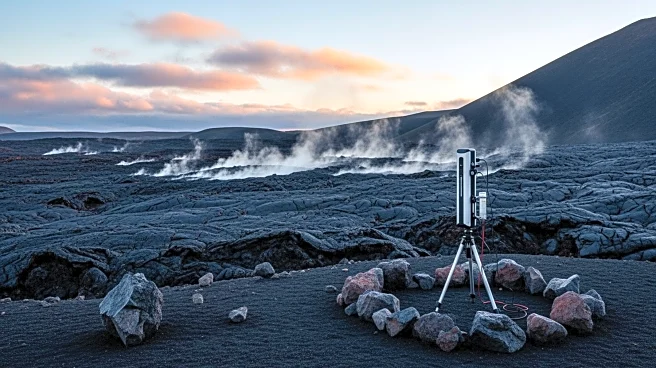
NASA's Goddard Instrument Field Team, known as 'Team Gas', conducted fieldwork in Southwest Iceland in 2025, focusing on volcanic carbon cycling. The team faced logistical challenges, including transporting heavy equipment to Lake Kleifarvatn and Lake Grænavatn.
Despite adverse weather conditions, they successfully deployed scientific instruments to study the lakes, which are remnants of volcanic explosions. The team collaborated with the Carb team to maximize scientific output, sharing samples and support. Their work aims to understand carbon cycling in volcanic environments, which is crucial for studying ocean worlds like Europa and Enceladus.
Why It's Important?
Understanding carbon cycling in volcanic environments is vital for assessing habitability on ocean worlds. The insights gained from this research could inform future studies on how carbon travels through potentially habitable zones on moons such as Europa and Enceladus. This knowledge is essential for astrobiology, as carbon is a fundamental building block for life and plays a role in climate regulation. The collaboration between different scientific teams enhances the scope and depth of the research, potentially leading to breakthroughs in planetary science and exploration.