







What's Happening?
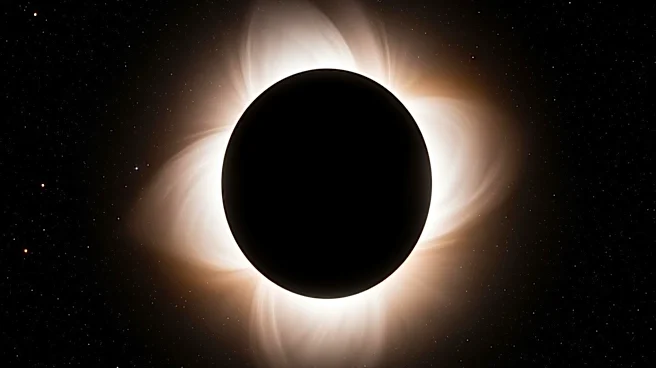
A total solar eclipse is set to occur on August 12, 2026, providing a rare celestial event visible across various parts of the world. The eclipse will be fully visible over the Arctic Ocean, Greenland, Iceland, Spain, and a small portion of northern Portugal.
In Europe, this will be the first total solar eclipse visible over mainland areas since 1999, with Spain and northern Portugal being the only locations on the continent to experience totality. Observers in the UK, Ireland, and the northernmost regions of the USA and Canada will witness a partial solar eclipse, with over 90% of the Sun obscured in many places. The eclipse will occur near lunar perigee, when the Moon is closest to Earth, making it appear slightly larger and resulting in a relatively long duration of totality, lasting over two minutes in some areas.
Why It's Important?
This solar eclipse is significant as it offers a unique opportunity for millions of people to experience a total or partial solar eclipse, an event that does not occur frequently in many parts of the world. For Europe, particularly Spain and Portugal, this marks the first total solar eclipse visible on the mainland in over two decades, potentially boosting tourism and interest in astronomical events. In North America, the partial eclipse will be visible in the northernmost regions, providing educational and observational opportunities for schools, amateur astronomers, and the general public. The event underscores the importance of scientific literacy and public engagement with natural phenomena, encouraging safe viewing practices and fostering a greater appreciation for astronomy.
What's Next?
As the date approaches, preparations for viewing the eclipse safely will become a priority. Public awareness campaigns will likely emphasize the importance of using certified solar eclipse glasses to prevent eye damage. Educational institutions and astronomy clubs may organize viewing events and workshops to educate the public about the science behind solar eclipses. Additionally, travel and tourism sectors in regions experiencing totality, such as Spain and Portugal, may see increased activity as eclipse chasers and tourists plan trips to witness the event. The eclipse also presents an opportunity for scientific research, with astronomers potentially conducting studies on solar phenomena during the eclipse.