




What's Happening?
West Virginia Attorney General J.B. McCuskey has intervened in a civil lawsuit filed by Warwood residents against Silicon Foundation Energy LLC, which is developing a data center on the former Centre Foundry & Machine Company property. The lawsuit, filed in Ohio
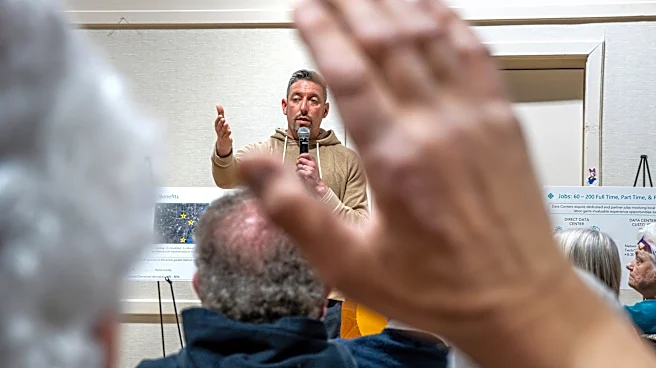
County Circuit Court, seeks to halt the data center's development and questions the constitutionality of House Bill 2014, known as the Power Generation and Consumption Act. This act, passed last year, regulates new data centers in West Virginia. The Attorney General's intervention is specifically to defend the constitutionality of HB 2014, not to take a stance on the factual allegations concerning the Warwood data center or its compliance with the bill's requirements. The court has granted the state's motion to intervene. Residents opposing the project argue that data centers were not envisioned for the industrially zoned area decades ago and express concerns about potential impacts on property values and health.
Why It's Important?
This intervention is significant as it directly addresses the legal framework governing data center development in West Virginia, particularly House Bill 2014. The outcome of this case could set a precedent for how future data center projects are regulated and challenged within the state. For the Silicon Foundation, a favorable ruling on HB 2014's constitutionality would remove a major legal hurdle, potentially facilitating the development of their Warwood data center and future projects. Conversely, if the court finds HB 2014 unconstitutional, it could empower local municipalities and residents to exert more control over such developments, potentially leading to increased regulatory complexities and delays for technology companies looking to establish operations in West Virginia. The case also highlights the growing tension between economic development initiatives, such as attracting data centers, and local community concerns regarding environmental impact, quality of life, and property values.
What's Next?
The case will proceed in Ohio County Circuit Court, with the State of West Virginia participating to defend the constitutionality of House Bill 2014. The Attorney General has stated that the state will limit its involvement to this constitutional defense. The court will need to rule on the plaintiffs' request for declaratory judgment, temporary protection order, and injunctive relief to prevent the data center's construction. Meanwhile, residents of Warwood are expected to continue their opposition, having already organized various efforts including websites, yard signs, and public appearances at city council meetings. The Wheeling City Council, while acknowledging legal limitations, is being urged by residents to advocate for their concerns. The Silicon Foundation will likely continue to assert that their project, initially planned as a 10-megawatt facility with potential expansion to 50 megawatts, falls below the 90-megawatt threshold for 'high-impact' data centers regulated by HB 2014.
Beyond the Headlines
This legal battle extends beyond the immediate data center project, touching upon broader themes of state versus local control, the interpretation of zoning laws in the face of new technologies, and the balance between economic growth and community well-being. The challenge to HB 2014 reflects a national trend where communities grapple with the implications of large-scale infrastructure projects, particularly those with significant energy and land use demands like data centers. The case could influence how other states craft legislation to attract or regulate technology investments, potentially leading to more robust local input mechanisms or clearer state-level guidelines. Furthermore, the residents' concerns about property values and health issues underscore the evolving understanding of the social and environmental footprint of digital infrastructure, prompting a reevaluation of how such facilities are integrated into existing communities.