

What's Happening?
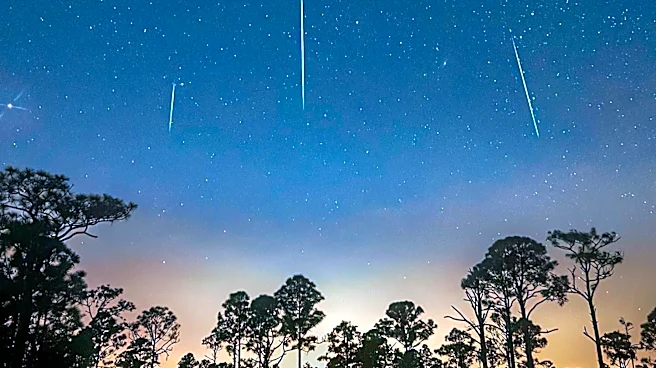
The Leonids meteor shower is currently peaking, with the most favorable viewing times occurring overnight Monday into early Tuesday. While not expected to be as intense as the historic 1966 meteor storm, this year's shower is anticipated to produce approximately
10 to 15 meteors per hour under ideal conditions. The Leonids are known for their fast-moving and often colorful meteors, traveling at about 44 miles per second, and can include fireballs and Earth-grazing meteors, according to NASA. The shower originates from debris left by Comet 55P/Tempel-Tuttle as Earth passes through its stream. Observers are advised to find a dark location away from city lights, allow their eyes at least 20 minutes to adjust to the darkness, and avoid looking at cell phones to ensure optimal viewing. The meteors will appear to radiate from the constellation Leo but can be seen across the entire night sky.
Why It's Important?
The Leonids meteor shower offers a recurring opportunity for public engagement with astronomy, encouraging individuals to look up and connect with the natural world. Although this year's display is modest, it serves as a consistent celestial event that can spark interest in space science and observational astronomy. For educational purposes, it highlights concepts such as cometary debris, Earth's orbit, and the physics of meteors. The advice to seek dark skies also implicitly raises awareness about light pollution, a growing concern for astronomers and environmentalists. The event provides a shared cultural experience, drawing people outdoors and fostering a sense of wonder, which can have positive impacts on community well-being and appreciation for scientific phenomena.
What's Next?
The Leonids meteor shower, which began in early November, will continue through the first few days of December. Looking ahead, the Leonids serve as a prelude to the more anticipated Geminids meteor shower, which is considered one of the major annual showers and is expected to peak on December 13-14. This provides another significant stargazing opportunity for enthusiasts. Additionally, the comet Tempel-Tuttle, responsible for the Leonids, is projected to return in 2031 and 2064, potentially bringing more spectacular meteor displays with rates exceeding 100 per hour. These future returns offer long-term anticipation for the astronomical community and the public.
Beyond the Headlines
The Leonids meteor shower, with its historical accounts of meteor storms, illustrates the dynamic and sometimes unpredictable nature of celestial events. The 1966 event, which saw thousands of meteors per minute, highlights the potential for truly awe-inspiring natural spectacles. These events connect us to a broader cosmic timeline, reminding us that the debris we observe today is from a comet that has been orbiting the sun for centuries. The scientific study of meteor showers provides valuable data on the composition of comets and the early solar system. Furthermore, the act of stargazing, particularly for events like the Leonids, can foster a sense of humility and wonder, encouraging contemplation of our place in the vast universe and promoting a deeper connection to the natural environment.