





What's Happening?
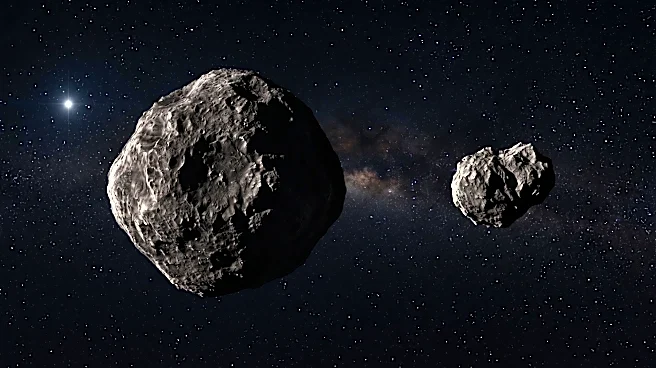
The European Space Agency’s (ESA) Hera spacecraft has successfully resolved the binary nature of the Didymos asteroid system, distinguishing its two target asteroids, Didymos and Dimorphos, for the first time. This achievement occurred on October 18,
with Hera imaging the asteroids from a distance of 1280 km using its monochromatic Asteroid Framing Camera. Previously, the system appeared as a single dot. Dimorphos, measuring 151 meters across, is now visible as a separate entity from the larger 780-meter Didymos. This milestone follows successful braking maneuvers earlier in the month, which slowed the spacecraft to 20 m/s relative to the asteroids, allowing for a fine-tuned approach. Mission manager Ian Carnelli noted that this marks the first time the mission is observing the double asteroid system through Hera's own instruments, with sharper views expected as the spacecraft draws closer.
Why It's Important?
This development is crucial for planetary defense efforts, as Hera's mission is to conduct a detailed 'crash site investigation' of Dimorphos. Dimorphos was the target of NASA's DART spacecraft in September 2022, an experiment that measurably shifted the asteroid's orbit. However, key unknowns remain regarding the impact's effect on the asteroid's physical properties, structure, and mass, which are vital for understanding and refining the 'kinetic impact' method of planetary defense. Hera's close-up observations, utilizing multiple instruments and deploying CubeSats, will provide unprecedented data. This information is essential for validating and improving impact simulations, ensuring that future planetary defense strategies are as effective as possible in protecting Earth from potential asteroid threats. The mission will unveil the first detailed images of Dimorphos on November 25.
What's Next?
Over the coming months, the Hera spacecraft will continue its approach to Dimorphos to perform a comprehensive investigation of the asteroid's impact site. This will involve using its array of instruments and deploying two shoebox-sized CubeSats for an even closer survey, eventually progressing to a landing. The mission aims to gather critical data on the precise makeup, structure, and mass of Dimorphos, which will help explain why the DART impact resulted in a greater orbital deflection than initially predicted by simulations. The first detailed images of Dimorphos are scheduled to be unveiled on November 25. This data will be instrumental in refining planetary defense techniques and understanding the long-term implications of kinetic impactors on asteroid bodies.
Beyond the Headlines
The Hera mission's success in resolving the Didymos-Dimorphos system underscores a significant advancement in humanity's capacity for planetary defense. Beyond the immediate scientific data, this mission represents a collaborative international effort to safeguard Earth, highlighting the growing importance of space safety and asteroid research. The detailed analysis of Dimorphos will not only enhance our understanding of asteroid composition and behavior but also inform future strategies for mitigating potential cosmic threats. This mission also pushes the boundaries of space exploration technology, particularly in autonomous navigation and close-proximity operations around celestial bodies. The insights gained could have broader implications for asteroid mining and understanding the early solar system, demonstrating a proactive approach to space stewardship and risk management.