





What's Happening?
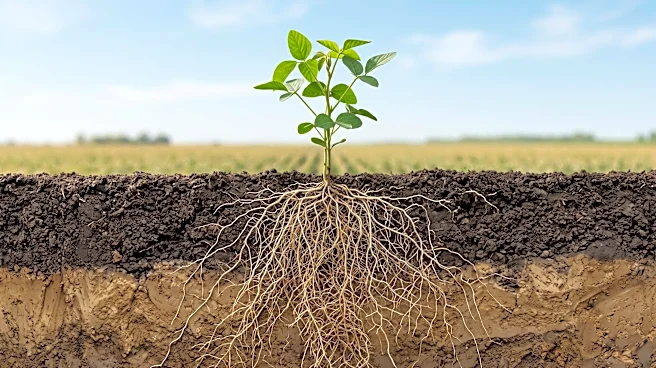
Researchers at the Salk Institute for Biological Studies are investigating whether genetically engineered crops with deeper root systems can help combat climate change. The goal is for these roots to withstand the effects of climate change, such as drought,
while also drawing more carbon from the atmosphere and storing it underground. Over the past six years, Salk scientists have created an 'encyclopedia' of plant genomes, identifying 347 genes related to carbon storage and root growth. By editing the DNA of common row crops like soybeans and sorghum, they have developed plants with roots that penetrate deeper into the soil. An $18 million grant from the Bezos Earth Fund is supporting field tests in Illinois, Missouri, Kansas, and Iowa to measure the resilience of these plants to climate stressors, their carbon storage capacity, and their potential for large-scale adoption on farms. Initial field results are expected this fall.
Why It's Important?
This research holds significant implications for U.S. agriculture and climate change mitigation efforts. Deeper-rooted crops could offer a dual benefit: enhancing food security by making plants more resilient to droughts and other climate stressors, and providing a natural solution for carbon sequestration. If successful, this technology could transform farming practices, allowing for more sustainable and productive agriculture in a changing climate. The ability to store carbon underground for extended periods could contribute substantially to reducing atmospheric carbon dioxide levels. Furthermore, these engineered crops could potentially absorb more nitrogen and other fertilizer runoff, mitigating environmental issues like algae blooms and low-oxygen environments in waterways. The rapid adoption of such technology, as seen with herbicide-resistant crops, could lead to a gigaton of carbon dioxide removal annually by 2040 if applied to major crops in countries where genetically modified crops are accepted.
What's Next?
The immediate next step involves analyzing the initial field test results expected this fall from sites in Illinois, Missouri, Kansas, and Iowa. These results will be crucial in validating the lab findings regarding carbon storage, drought resilience, and yield maintenance under real farming conditions. If the field tests prove successful, the focus will shift towards scaling up the technology and encouraging widespread adoption by farmers and seed companies. This will require demonstrating clear benefits to farmers, potentially through subsidies and other incentives, and addressing any concerns about new crop technologies. Researchers will also need to continue studying the long-term stability of carbon stored underground and the overall ecological impacts of these genetically modified crops. The development and deployment of these crops are seen as a race against time to limit climate damage and prevent irreversible tipping points.
Beyond the Headlines
Beyond the immediate scientific and agricultural benefits, this research touches upon deeper ethical and societal considerations regarding genetic engineering in food production. While offering a powerful tool for climate mitigation, the introduction of genetically modified organisms (GMOs) into the food supply often raises public concerns about safety, biodiversity, and corporate control over seeds. The success of this initiative will depend not only on scientific efficacy but also on public acceptance and effective communication about the benefits and risks. Moreover, the project highlights the critical role of private funding, such as the Bezos Earth Fund, in driving large-scale climate solutions. This raises questions about the balance between public and private investment in addressing global challenges and the potential influence of private entities on agricultural research and policy. The long-term implications could reshape the agricultural landscape, potentially leading to a more resilient and carbon-negative food system, but also necessitating careful consideration of its broader societal and environmental impacts.